
Passport Application Guide (2026): Complete Online Process & Requirements

Passport applications are an essential part of preparing for international travel. If you’re planning an overseas trip, moving abroad for work, studying in another country, or travelling internationally for business, having a valid Australian passport is a must. The Australian Passport Office allows eligible Australian citizens to begin their passport application or passport renewal online before attending an authorised lodgement location to verify their identity and submit the required supporting documents.

Passport applications are easier when you start with the correct information. Understanding the official requirements in advance can save time and reduce the risk of delays. This guide covers the complete Australian passport application process, including eligibility, passport types, required documents, current fees, processing times, and the step-by-step process for submitting an application through the official Australian Passport Office.

Understanding the Australian Passport Office

The Australian australian pass port Office is the government authority responsible for issuing Australian pass ports and travel documents. It operates under the Department of Foreign Affairs and Trade (DFAT) and manages pass port services for Australian citizens both within Australia and overseas.

Through its official online portal, applicants can access a range of australian pass port-related services, including:

  • Apply for a new Australian pass port
  • Renew an eligible pass port
  • Replace a lost, stolen, or damaged pass port
  • Update personal pass port information
  • View current pass port fees
  • Check pass port photo requirements
  • Locate pass port offices and lodgement centres
  • Access pass port services while overseas
  • Find information about pass port applications and processing

Official Website

Who Is Eligible to Apply?

Australian australian pass ports are available to Australian citizens who can prove their citizenship and identity with acceptable original documentation.

Applications can be submitted by:

  • First-time australian pass port applicants
  • Adults applying for a new australian pass port
  • Children under 16 years of age
  • Senior citizens
  • Australians living overseas
  • Citizens renewing an existing australian pass port

Australian Passport Categories

The Australian Pass port Office issues several australian pass port types to meet different travel needs and eligibility requirements.

Passport TypeStandard Validity
Adult Pass port (16 years and over)10 Years
Child Pass port (Under 16 years)5 Years
Optional Senior Pass port (75 years and over)5 Years
Emergency Pas sportLimited validity
Overseas Pass port ServicesAvailable through Australian embassies and consulates

Before beginning your application, make sure you choose the australian pass port category that best matches your situation.

Australian Passport Fees (2026)

australian pass port charges are reviewed annually, so applicants should always confirm the latest prices before making payment.

australian passport ServiceApproximate Fee (AUD)
Adult Pass port$398
Child Pass port$201
Optional Senior Pass port$201
Overseas Adult Surcharge$155
Overseas Child Surcharge$78
Priority Processing$252

How Long Does Passport Processing Take?

Your application will only enter the processing queue once all required steps have been completed successfully. This includes:

  • Identity verification
  • Lodging the application in person
  • Submission of all original supporting documents
  • Successful payment of the applicable fees

Standard Service

Most standard australian pass port applications are processed within up to six weeks.

Priority Service

Applicants who qualify for priority processing may receive their australian pass port within two business days after the application has been correctly lodged. This service is available only at selected australian pass port offices and requires an additional priority processing fee.

To avoid travel disruptions, wait until your new australian pass port has been issued before making non-refundable international travel bookings. Visit Homepage

Documents You’ll Need Before Applying

Preparing your documents before starting the application helps make the process smoother and reduces the likelihood of delays.

Proof of Australian Citizenship

Applicants must provide an original document confirming Australian citizenship, such as:

  • Australian Birth Certificate
  • Australian Citizenship Certificate

Unless specifically requested, photocopies are generally not accepted.

Identity Documents

You’ll also need acceptable identification to verify your identity. Common examples include:

  • Australian Driver Licence
  • Proof of Age Card
  • Another government-issued photo identification

These documents confirm your identity before a australian pass port can be issued.

Evidence of Your Residential Address

Some applicants may need to provide proof of their current address. Suitable documents can include:

  • Utility bills
  • Bank statements
  • Official government correspondence

The document should clearly display your current name and residential address.

Name Change Documents

If your legal name has changed since your citizenship document was issued, you’ll need official evidence, such as:

  • Marriage Certificate
  • Change of Name Certificate
  • Deed Poll documentation

Passport Photographs

Australian australian pass port photographs must meet strict quality and formatting requirements.

Generally, applicants must provide:

  • Two identical printed australian pass port photographs
  • White or off-white background
  • Neutral facial expression
  • Photos taken within the previous six months
  • Professionally printed, high-quality images

For many first-time applications, one photograph must also be signed by an eligible guarantor.

Complete photo specifications are available on the Australian australian pass port

Guarantor Requirements

Certain applications require a guarantor to verify your identity.

A guarantor must:

  • Be an Australian citizen
  • Be at least 18 years of age
  • Have known you personally for at least one year
  • Not be a relative
  • Not live at your residential address

Where required, the guarantor completes the relevant section of the application and signs the back of one australian pass port photograph.

Checklist Before You Begin

Before opening the online application, make sure you have prepared the following:

  • A valid email address
  • Original Australian citizenship documents
  • dentity documents
  • australian pass port photographs
  • Current residential address details
  • Guarantor information (if applicable)
  • A payment method for australian pass port fees

Having everything ready before you start can make the application process faster and help avoid unnecessary delays.

Step 1: Visit the Official Australian Passport Office Website

To begin your application, visit the official Australian australian pass port Office website and choose “Apply or Renew.”

New applicants will be asked to create an online account using a valid email address. Existing users can sign in to continue an application or manage an existing australian pass port request.

After your account has been verified, the system will guide you through the correct application based on your circumstances, whether you’re applying for your first australian pass port, renewing an existing one, or replacing a lost, stolen, or damaged pass port.

The online application collects your personal details and prepares your application form. Once completed, you’ll need to print the form and lodge it in person with your original documents at an authorised australian pass port office or participating Australia Post outlet.

Step 2: Fill Out the Online Passport Application

Once you’ve created your account and selected “Apply or Renew,” you’ll be directed to the online australian pass port application form. Take your time when completing each section and make sure every detail matches your official citizenship and identity documents exactly.

Even minor errors—such as an incorrect spelling, wrong birth date, or mismatched address—can lead to processing delays or require further verification.

During the application, you’ll usually be asked to provide:

  • Full legal name
  • Date and place of birth
  • Gender
  • Residential and postal address
  • Email address and contact number
  • Australian citizenship details
  • Previous australian pass port information (if applicable)
  • Guarantor details (where required)

Before submitting the form, review all information carefully. Correcting mistakes after submission may take additional time and could delay the progress of your application.

Step 3: Download and Print Your Application Form

After you’ve completed the online application, the system will generate a printable PDF version of your australian pass port application.

To ensure your form is accepted, remember to:

  • Print every page on one side only.
  • Use clean white A4 paper.
  • Make sure all pages are clear and easy to read.
  • Do not write additional notes or alter the printed form.

If any page prints incorrectly or becomes damaged, simply print a new copy before attending your appointment.

Step 4: Sign and Date the Printed Form

Before lodging your application, you’ll need to sign the printed form using black ink.

When signing, make sure to:

  • Keep your signature completely inside the signature box.
  • Avoid touching or crossing the border lines.
  • Use your normal legal signature.
  • Enter the correct date beside your signature.

A signature outside the allocated area may make the form invalid, requiring you to print and sign a new application.

Step 5: Have Your Guarantor Complete Their Section (If Required)

If you’re applying for your first Australian australian pass port or your application requires identity verification, you’ll need an eligible guarantor.

The guarantor must complete the designated section of the printed application before you lodge it.

They are also required to write the following statement on the back of one australian pass port photograph:

After writing the statement, the guarantor must sign beneath it.

To qualify as a guarantor, the person must:

  • Be an Australian citizen.
  • Be at least 18 years old.
  • Have known you personally for a minimum of one year.
  • Not be related to you.
  • Not live at your residential address.

Applications may be delayed or rejected if the guarantor does not meet these requirements.

Step 6: Lodge Your Passport Application

Completing the online form is only the first stage. Your australian pass port application must still be lodged in person before processing can begin.

If You’re Applying in Australia

Visit a participating Australia Post australian pass port outlet and bring:

  • Printed australian pass port application form
  • Original proof of identity
  • Australian citizenship documents
  • australian pass port photographs
  • Payment method for the applicable fees

If You’re Applying Overseas

Australian citizens living outside Australia should submit their application at the nearest:

  • Australian Embassy
  • Australian High Commission
  • Australian Consulate

Many overseas offices require appointments, so it’s a good idea to check availability before visiting.

Step 7: Pay the Passport Fee

Payment is made when you lodge your application.

The total amount payable depends on several factors, including:

  • The australian pass port type selected
  • Applicant’s age
  • Whether priority processing has been requested
  • Whether the application is lodged within Australia or overseas

For the latest fee schedule, always refer to the official Australian australian pass port Office website.

Australian Passport Renewal Process

Eligible Australians can often renew their australian pass port through a simplified renewal process.

In most cases, you may qualify if your previous australian pass port:

  • Was issued when you were at least 16 years old
  • Had a validity of at least two years
  • Has not been reported lost or stolen
  • Is not significantly damaged

If you’re unsure whether you qualify, the online renewal service will determine your eligibility during the application process.

Renewal Step 1: Check Your Eligibility
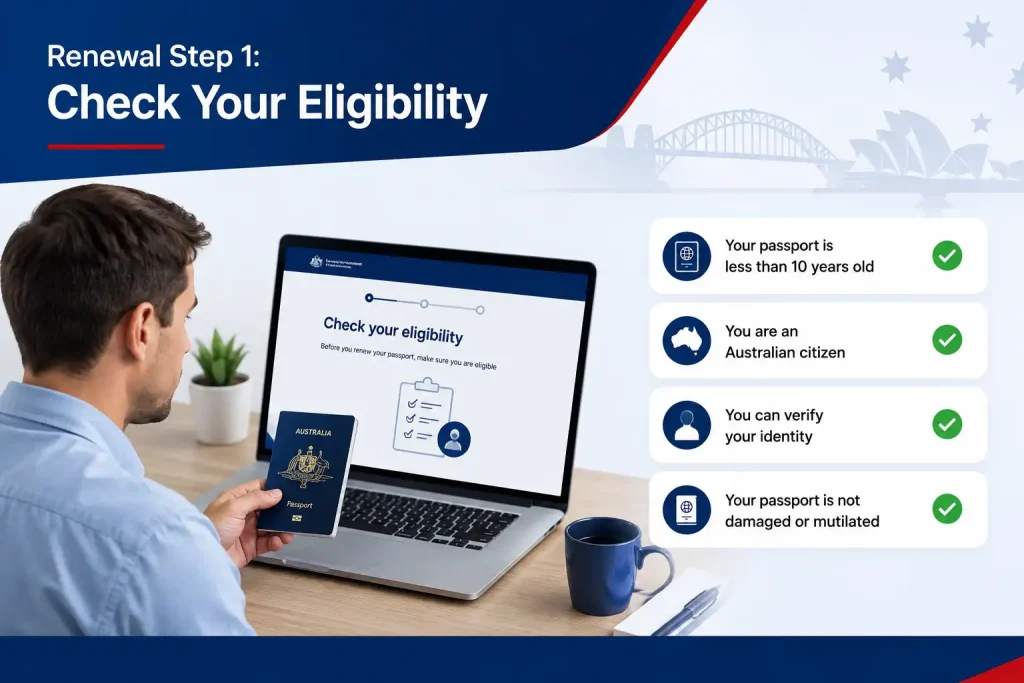
Renewal Step 1 Check Your Eligibility for Australian passport renewal online through the official Australian Passport Office website.

Visit the official Australian australian pass port Office website and select the australian pass port renewal option.

The online system will assess whether your existing australian pass port qualifies for the streamlined renewal process.

Renewal Step 2: Generate Your Pre-filled Renewal Form

Generate your pre-filled renewal form online through the official Australian Passport Office passport renewal portal.

If you’re eligible, the system will automatically prepare a renewal application containing much of your existing australian pass port information.

This reduces the amount of information you need to enter and can make the renewal process quicker than applying for a new australian pass port.

Before printing, review every section carefully to ensure all details remain correct.

Renewal Step 3: Print and Sign the Renewal Form
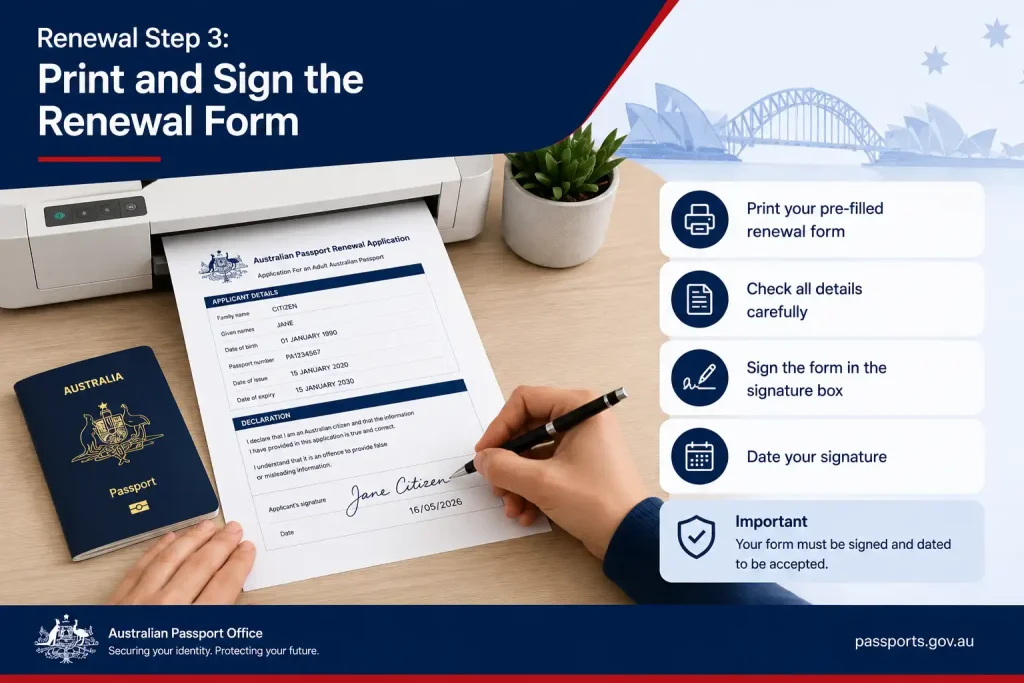
Print and sign the Australian passport renewal form before submitting your passport renewal application.

Print the completed renewal form using single-sided printing on standard A4 paper.

Sign the application inside the designated signature box using black ink.

Renewal Step 4: Obtain New Passport Photos

Obtain new passport photos that meet Australian Passport Office requirements before renewing your Australian passport.

Every renewal application requires two recent pass port photographs that comply with the latest Australian Pass port Office photo standards.

Most eligible renewals do not require a guarantor, although certain applications may still require one depending on individual circumstances.

Renewal Step 5: Lodge Your Renewal Application
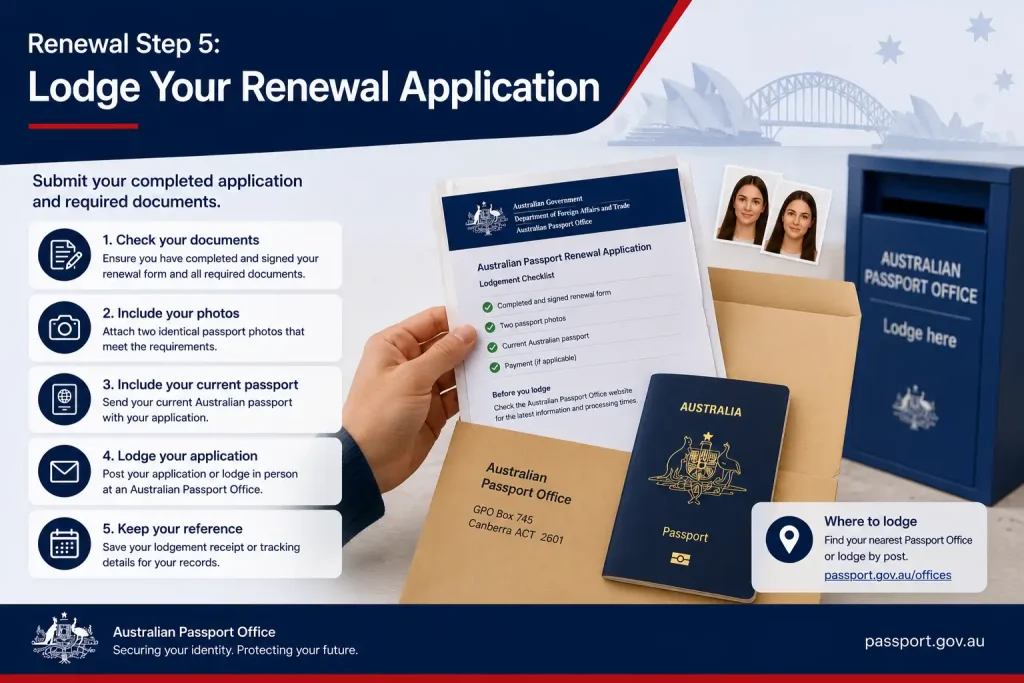
Lodge your Australian passport renewal application with the completed form, passport photos, and required documents.

Take the following items to an authorised pass port acceptance location:

  • Signed renewal application
  • Current pass port
  • Two new pass port photographs
  • Payment for the applicable renewal fee

Once your application has been accepted, pass port processing officially begins.

Checking the Status of Your Passport Application

After lodging your application, you can monitor its progress through your account on the Australian Pass port Office website.

Depending on where your application is in the process, you may see updates such as:

  • Application received
  • Identity verification in progress
  • Processing underway
  • Additional information requested
  • Pass port printed
  • Pass port dispatched or ready for collection

Checking your account regularly is the quickest way to stay informed about your application’s status.

Receiving Your New Australian Passport

When your application has been approved, your pass port will be issued using the delivery method appropriate to your circumstances.

You may either:

  • Receive your pass port by registered post at your nominated address, or
  • Collect it from the pass port office or acceptance location where your application was lodged.

Applicants who submit their application outside Australia will be contacted by their Australian Embassy, High Commission, or Consulate once the pass port is available for collection.

Common Reasons Australian Passport Applications Are Delayed

Many pass port applications are held up because of avoidable mistakes made during the application process. Spending a few extra minutes reviewing your documents before lodging them can save weeks of unnecessary delays.

The most common issues include:

  • Entering incorrect or incomplete personal details.
  • Submitting pass port photographs that don’t meet official requirements.
  • Forgetting to sign and date the printed application.
  • Providing photocopies instead of original supporting documents.
  • Leaving the guarantor section incomplete when one is required.
  • Printing the application on both sides of the paper instead of single-sided.
  • Applying only a few days before your planned overseas trip.

A careful final review before lodging your application is one of the easiest ways to avoid processing delays.

Australian Passport Photo Guidelines

Your pass port photograph plays a vital role in the approval process. If the photo doesn’t comply with the Australian Pass port Office’s standards, your application may be returned or delayed.

To meet the official requirements, your pass port photos should:

  • Be taken within the last six months.
  • Use a plain white or off-white background.
  • Show a neutral facial expression.
  • Be professionally printed with high image quality.
  • Avoid sunglasses or tinted eyewear unless supported by a medical reason.
  • Comply with all current Australian pass port photo specifications.

If your application requires a guarantor, one of the photographs must also be correctly endorsed before your application is lodged.

For the latest specifications, refer to the official Australian Pass port Office website.

Lost, Stolen or Damaged Australian Passport

If your pass port has been lost, stolen, or seriously damaged, report it immediately to help protect your identity and prevent unauthorised use. Once reported, the pass port may be cancelled to ensure it cannot be misused.

Depending on the circumstances, you’ll usually need to submit a replacement pass port application along with any additional information requested by the Australian Pass port Office.

If you’re travelling or living overseas, contact your nearest Australian Embassy, High Commission, or Consulate for assistance with replacing your pass port.

Tips for a Faster and Smoother Passport Application

Preparing in advance can make the entire application process much easier.

Before lodging your application, remember to:

  • Apply well before your intended departure date.
  • Gather all original documents before starting the online application.
  • Use pass port photographs that fully comply with official standards.
  • Double-check every section of your application for accuracy.
  • Sign the printed form in black ink within the designated signature box.
  • Attend your lodgement appointment with every required document.
  • Regularly check your online account for application updates.
  • Keep your receipt and application reference details until your pass port has been issued.

Following these simple steps can help reduce the likelihood of delays.

Why Use the Official Australian Passport Office Website?

Using the official government website gives you access to accurate, up-to-date information and secure online pass port services.

Some of the key advantages include:

  • Secure online pass port applications
  • Official pass port renewal services
  • Current fees and processing times
  • Eligibility information for new and renewal applications
  • Official pass port photo requirements
  • Pass port services for Australians overseas
  • Guidance for lost, stolen, or damaged pass ports
  • Travel document information
  • Pass port office and lodgement location finder
  • Application status and tracking information

FAQs

It looks like you’ve pasted a section about the Six-Month Passport Validity Rule. Here’s a completely rewritten version that preserves the meaning while making it more readable, original, and SEO-friendly, following the rewriting principles in your uploaded prompt.

Understanding the Six-Month Passport Validity Rule

Many countries require travellers to hold a passport that remains valid for at least six months beyond their planned travel dates. This requirement, commonly known as the Six-Month Passport Validity Rule, is enforced by numerous immigration authorities and recognised by U.S. Customs and Border Protection for many international visitors. Failing to meet this requirement can result in denied boarding or refusal of entry, even if your passport has not yet expired.

Why Do Countries Require Six Months of Passport Validity?

The rule exists for several practical reasons that help both travellers and immigration authorities.

  • Avoids travel disruptions: If your trip is unexpectedly extended because of illness, cancelled flights, or emergencies, your passport remains valid throughout your stay.
  • Prevents immigration issues: Authorities want to reduce the risk of visitors remaining in the country with an expired passport.
  • Supports airline compliance: Airlines are responsible for checking passport validity before departure and may refuse boarding if your passport does not satisfy the destination country’s requirements.

How the Six-Month Rule Is Applied

The way this rule is calculated depends on the country you plan to visit.

  • Some destinations require your passport to be valid for six months from the date you arrive.
  • Others require six months beyond your planned departure date.
  • Not every country follows the same policy. Certain destinations require only three months of remaining validity, while others simply require that your passport remains valid for the duration of your visit.

Because entry requirements vary between countries and can change over time, checking the official travel guidance for your destination before booking your trip is always recommended.

Important Travel Tip

Many experienced travellers recommend verifying passport validity requirements well in advance of your departure. A quick check before booking flights can help you avoid unexpected cancellations, denied boarding, or problems at immigration, ensuring your journey begins without unnecessary delays.

Here’s a fully rewritten, SEO-friendly version of your section while preserving all factual information. It follows the rewriting guidance from your uploaded prompt by restructuring the content rather than paraphrasing it line by line.

How to Print Your Australian Passport Application Checklist

After completing your passport application online, you’ll need to print the personalised application checklist before attending your passport appointment. The Australian Passport Office generates this checklist as a PDF once you’ve answered all required questions in the online application. Printing it correctly is important because unclear or incorrectly formatted documents may delay your application.

Step 1: Sign In to the Australian Passport Portal

Visit the official Australian Passport Office online application portal and sign in using your existing account. If you’ve already started an application, open the saved form to continue where you left off.

Step 2: Complete Your Application

Finish answering all required questions in the online application. Once every mandatory section has been completed, the system will automatically create your personalised passport application summary and checklist.

Step 3: Download the PDF

When your application is ready, download the generated PDF file and save it to your computer, tablet, or mobile device so you can print it later if needed.

Step 4: Check Your Printer Settings

Before printing, make sure your printer is configured correctly:

  • Use white A4 paper only.
  • Print in portrait orientation.
  • Select black ink for the entire document.
  • Enable “Fit to page” or “Fit to printable area” so nothing is cropped, especially the barcodes and page edges.

Step 5: Print and Review the Checklist

Print the PDF and carefully inspect the finished document. Ensure the print quality is sharp, all text is readable, and the barcodes at both the top and bottom of the page are fully visible. If any section has been cut off or printed poorly, adjust your printer settings and print a new copy before submitting your passport application.

Here’s a completely rewritten version of your section. It preserves the original meaning and factual information while improving readability, flow, and SEO.

How to Apply for an Australian Passport

Applying for an Australian passport is a straightforward process when you have the required documents ready. Before submitting your application, you’ll need to confirm your identity, provide proof of Australian citizenship, obtain compliant passport photos, and complete the official application form. Once everything is prepared, your application must be lodged in person at a participating Australia Post outlet or another approved passport acceptance facility.

Step 1: Gather Your Required Documents

Start by collecting your original supporting documents. You’ll generally need evidence of your Australian citizenship, such as an original birth certificate or citizenship certificate, along with identity documents like a driver’s licence or Medicare card. Ensure all documents are current, original, and in good condition.

Step 2: Get Passport Photos Taken

Arrange for two recent passport photographs that meet the Australian Passport Office’s photo standards. The photos must be identical, clear, and comply with the official size, background, and quality requirements. Photos that don’t meet these standards may result in processing delays.

Step 3: Complete the Passport Application

You can complete your passport application online through the Australian Passport Office or obtain a paper application form from a participating Australia Post outlet. Carefully review all personal details before finalising the form to avoid unnecessary delays.

Step 4: Have a Guarantor or Referee Verify Your Identity

If your application requires identity verification, ask an eligible guarantor or referee to confirm your identity. They must sign the required sections of your application and endorse the back of one passport photograph in accordance with the official guidelines.

Step 5: Print, Lodge Your Application, and Pay the Fee

After completing the application, print the form and take it, along with your original supporting documents and passport photos, to an approved Australia Post passport office. You’ll also need to pay the applicable passport fee at the time of lodgement.

As of 2026:

  • 10-year adult passport: AUD $422
  • Child passport: AUD $213

Standard passport applications are typically processed within approximately six weeks, although processing times may vary depending on demand and the completeness of your application. Checking that every document is accurate before lodging your application can help prevent unnecessary delays.

Here’s a fully rewritten, SEO-friendly version of your section. It preserves the original meaning while improving clarity, readability, and structure, in line with your rewriting prompt.

Essential Passport Rules for International Travel

Before booking an overseas trip, it’s important to make sure your passport meets the entry requirements of your destination country. Many immigration authorities and airlines enforce strict passport rules, and failing to meet them could result in denied boarding or refusal of entry. Checking your passport’s validity, condition, and personal details before travelling can help you avoid unnecessary disruptions.

Ensure Your Passport Has Sufficient Validity

A large number of countries require your passport to remain valid for at least six months beyond your intended travel dates. Depending on the destination, the six-month validity period may be calculated from your arrival date or your planned departure date. If your passport is close to expiring, renewing it before booking international travel is the safest option.

Keep Enough Blank Visa Pages

Your passport should contain at least two blank visa pages for immigration stamps and visas. If there are no available pages, some countries may refuse entry even if the passport itself is still valid.

Check the Physical Condition of Your Passport

Border authorities may reject passports that are damaged or difficult to read. Before travelling, inspect your passport for issues such as:

  • Torn or missing pages
  • Water damage
  • Detached or loose covers
  • Damaged photo or personal information page

If your passport has significant damage, apply for a replacement before your trip.

Make Sure Your Booking Matches Your Passport

The name on your airline ticket should be identical to the name printed on your passport, including middle names where required by the airline. Even small differences in spelling can cause problems during check-in or automated boarding.

If you’ve recently changed your legal name because of marriage or another legal process, update your passport before making any international travel bookings.

Be Aware of Destination-Specific Requirements

Some countries have additional passport and entry requirements beyond standard validity rules. For example:

  • UK and Irish dual nationals should enter the United Kingdom using their British or Irish passport, where applicable.
  • Many destinations now require travellers to obtain an Electronic Travel Authorisation (ETA) or another digital travel approval before departure. These approvals are electronically linked to your passport number, so any passport renewal may require a new travel authorisation.

Travel Preparation Tip

Before every international trip, confirm your destination’s passport validity requirements, visa conditions, and any electronic travel authorisations using official government travel advice. Spending a few minutes checking these requirements can help you avoid delays, denied boarding, or unexpected problems at immigration.

Here’s a fully rewritten, SEO-friendly version of your section. It preserves the original meaning while improving readability, organisation, and flow, without copying the source wording.

Important International Passport and Border Updates for 2026

Several countries are introducing new border control measures in 2026 that could affect international travellers. These changes include updated entry requirements for the United Kingdom, expanded digital travel authorisations, and the gradual introduction of Europe’s biometric border system. Checking the latest rules before departure can help you avoid delays or denied boarding.

United Kingdom Introduces New Entry Rules for Dual Citizens

From 25 February 2026, the United Kingdom has updated its travel requirements for people who hold British or Irish citizenship alongside another nationality.

Key changes include:

  • Dual British or Irish citizens cannot use an Electronic Travel Authorisation (ETA) to enter the UK.
  • They must travel using a valid British or Irish passport, or another approved document such as a Certificate of Entitlement where applicable.
  • Travelling with only a foreign passport may prevent boarding or entry into the UK.

Airlines Will Verify Travel Documents Before Boarding

Airlines are required to confirm that passengers have the correct travel permission before departure. Because carriers can face significant penalties for transporting travellers without valid documentation, they will refuse boarding if your passport or travel authorisation does not meet the destination country’s entry requirements.

Before travelling, make sure your passport details and any required electronic travel permissions are valid and linked correctly to your journey.

Europe’s Entry/Exit System (EES) Expands in 2026

The European Union’s Entry/Exit System (EES) is being introduced in phases through April 2026 for eligible non-EU travellers visiting the Schengen Area.

Under this new system:

  • Passport details are recorded electronically when entering or leaving participating countries.
  • Travellers will provide biometric information, including fingerprints and a facial image, at designated self-service kiosks or border checkpoints.
  • Entry and exit records are stored digitally, reducing reliance on traditional passport stamps.

Electronic Travel Authorisations Become More Common

Many destinations now require travellers to obtain an Electronic Travel Authorisation (ETA) or similar digital entry approval before departure. These authorisations are electronically linked to your passport number, so if you renew or replace your passport, you may also need to apply for a new travel authorisation before your trip.

Travel Preparation Checklist for 2026

Before travelling internationally, take a few minutes to confirm that you have:

  • A passport that meets your destination’s validity requirements.
  • The correct passport for your citizenship status, if you hold dual nationality.
  • Any required ETA, visa, or digital travel authorisation.
  • Up-to-date information on destination-specific border procedures, including biometric screening where applicable.

Before travelling overseas, always check that your passport satisfies your destination’s entry requirements. Many countries require your passport to remain valid for at least six months beyond your planned travel dates, and some airlines will refuse to let you board if your passport does not meet this minimum validity period. Because passport rules differ between countries, it’s a good idea to review the official travel advice for your destination before booking flights or departing, helping you avoid unexpected delays or denied boarding.

You can travel with a passport that has five months of validity remaining, but whether you’re allowed to board or enter your destination depends on that country’s passport validity requirements. Many countries require passports to remain valid for at least six months beyond your arrival or departure date, meaning a passport with only five months left may not be accepted. Other destinations apply a three-month validity rule, in which case your passport may still be valid for travel. It’s also important to check the rules for any transit countries on your itinerary, as they may have their own entry requirements. Because airlines verify passport validity before departure, they can refuse boarding if your passport does not meet the destination’s requirements. Before booking or travelling, always confirm the latest passport validity rules for every country on your itinerary to avoid unexpected travel disruptions.

You can continue using your passport right up until its expiry date, but whether it will be accepted for travel depends on the entry requirements of the countries on your itinerary. Many destinations require passports to remain valid for three to six months beyond your planned travel dates, and airlines routinely check these rules before allowing passengers to board. If your journey includes connecting flights, remember that transit countries may also have their own passport validity requirements, even if you do not leave the airport.

Outside of international travel, an expired Australian passport may still be accepted as secondary proof of identity for certain government services or licensing purposes for a limited period after expiry, depending on the organisation’s policies. However, an expired passport cannot be used as a valid travel document for international journeys or as identification for air travel. Before making travel arrangements, review your destination’s passport validity rules and ensure your passport has sufficient remaining validity to avoid delays, denied boarding, or entry issues.

Whether you can travel with less than six months remaining on your passport depends on the entry requirements of the country you’re visiting. While many destinations enforce a six-month passport validity rule, others have different standards. For example, most countries in the European Union and the Schengen Area generally require your passport to remain valid for at least three months after your planned departure, and it must also have been issued within the previous ten years. Some countries only require your passport to be valid for the length of your stay, while many non-EU destinations continue to apply the stricter six-month rule.

Even if your destination accepts a passport with fewer than six months remaining, airlines may still refuse boarding if your travel documents do not satisfy the country’s immigration requirements. Before booking flights or travelling, always check the latest official entry rules for your destination and any transit countries to ensure your passport meets the required validity period. Taking a few minutes to verify these requirements can help you avoid unexpected boarding issues or delays at the border.

Renewing your passport 9 to 12 months before it expires is generally recommended, especially if you expect to travel internationally. Many countries require passports to remain valid for at least six months beyond your travel dates, and waiting until the last minute could affect your travel plans. In Australia, standard passport renewals typically take at least six weeks to process, not including delivery time, so applying early provides extra time in case of delays.

Renewing in advance also has another advantage: any unused validity on your current passport is not transferred to your new passport, so postponing your renewal offers little benefit. If your adult passport was issued on or after 1 January 2006 with at least two years’ validity, you may be eligible for the streamlined renewal process instead of completing a full passport application. The main reason to delay renewal is if your current passport contains valid physical visas that you still need to use, or if you have no international travel planned for the foreseeable future. Even then, renewing before your passport enters its final months of validity can help you avoid unexpected travel disruptions.

Final Thoughts

Applying for an Australian pass port doesn’t have to be complicated. With the right preparation and the correct supporting documents, you can complete the application process confidently and minimise the risk of delays.

Whether you’re applying for your first pass port, renewing an existing one, replacing a lost pass port, or lodging an application from overseas, following the official Australian Pass port Office process ensures your application is handled correctly from start to finish.

Before submitting your application, take time to review every detail, confirm the latest pass port fees, and make sure your photographs meet the required standards. Preparing early is especially important if you have upcoming international travel plans.

By relying on the official Australian Pass port Office for guidance and following each step carefully, you’ll be well prepared to complete your application and track its progress until your new Australian pass port is ready.

Read More:
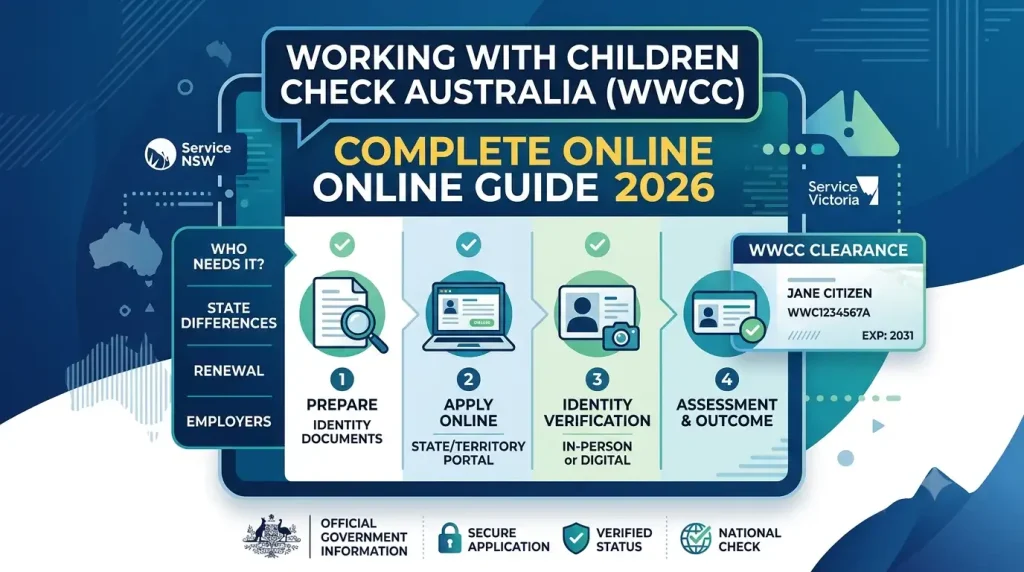
Working With Children Check Australia (WWCC): Complete Online Guide 2026

Storypark Login Made Simple: The Complete Access Guide for Families (2026)

Student Portal Navigator: The Ultimate Campus Access Guide (2026)

Leave a Comment

Your email address will not be published. Required fields are marked *

Scroll to Top