
Essential Assessment: The Complete Educator’s Handbook (2026)

Who Can Use Essential Assessment?

Different users have access to specific tools and features depending on their role within the school.

Teachers

Teachers use the platform to simplify assessment and classroom planning. They can:

  • Create and assign assessments
  • Monitor individual and class performance
  • Identify learning misconceptions
  • Generate detailed curriculum reports
  • Plan differentiated instruction based on assessment data

School Administrators

Administrators have access to school-wide management features, including:

  • Managing school accounts
  • Controlling teacher permissions
  • Organising student enrolments
  • Creating and maintaining class structures
  • Reviewing whole-school assessment reports

Students

Students use Essential Assessment to complete learning activities assigned by their teachers. They can:

  • Take online assessments
  • Access personalised learning tasks
  • View available classroom activities
  • Strengthen their understanding through targeted practice

Official Essential Assessment Website

For the safest experience, always sign in through the official Essential Assessment website provided by your school.

Available login portals include:

  • Teacher and Administrator Portal – for educators and school staff
  • Student Portal – for students completing assigned assessments

Using the official platform ensures access to the latest features, security improvements, and official support resources.

Key Features of Essential Assessment

Essential Assessment provides a wide range of tools that support effective teaching, accurate assessment, and ongoing student development.

Curriculum-Aligned Assessments

Every assessment is carefully mapped to recognised Australian curriculum standards, helping teachers evaluate student achievement against required learning outcomes.

Diagnostic Assessments

Diagnostic tools help teachers identify where students need additional support before new learning begins. These assessments highlight:

  • Existing knowledge
  • Learning strengths
  • Areas requiring improvement
  • Curriculum misconceptions

Formative Assessment

Regular formative assessments allow teachers to monitor student understanding throughout a learning unit. Immediate feedback helps guide classroom instruction before final assessments are completed.

Summative Assessment

Teachers can compare assessment results over time to measure learning growth and evaluate student achievement across different curriculum strands.

Instant Reporting

Results are automatically processed once assessments are completed, giving teachers fast access to detailed reports without spending hours marking student work.

Personalised Learning Activities

Based on assessment performance, students receive learning activities tailored to their individual needs. This targeted approach allows them to practise skills requiring additional attention while reinforcing concepts they already understand.

Benefits of Essential Assessment

Many Australian schools rely on Essential Assessment because it simplifies assessment while providing valuable insights into student learning.

Some of the major benefits include:

  • Reduces manual marking time
  • Delivers immediate assessment results
  • Tracks student progress throughout the year
  • Supports data-informed teaching decisions
  • Quickly identifies curriculum gaps
  • Encourages personalised learning pathways
  • Improves lesson planning
  • Assists with school reporting requirements

Teacher Login Guide

Teachers and administrators can access their accounts by following these simple steps.

Step 1: Open the Official Login Page
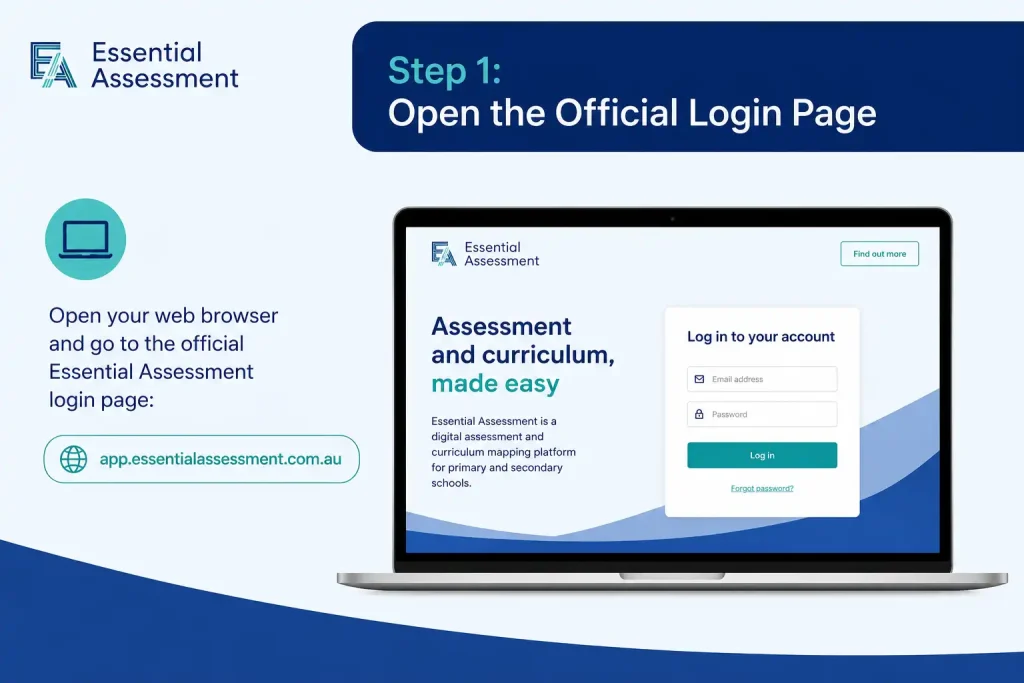
Essential Assessment official login page displayed on a laptop, showing the first step to securely access the student and teacher portal.

Visit the official Essential Assessment website and select the Teacher Login option.

Step 2: Enter Your Login Credentials

Essential Assessment login screen showing email address and password fields for secure student and teacher sign in.

Sign in using your registered school email address and password.

If your school uses Google or Microsoft Single Sign-On (SSO), simply choose the appropriate sign-in option.

Step 3: Access the Dashboard
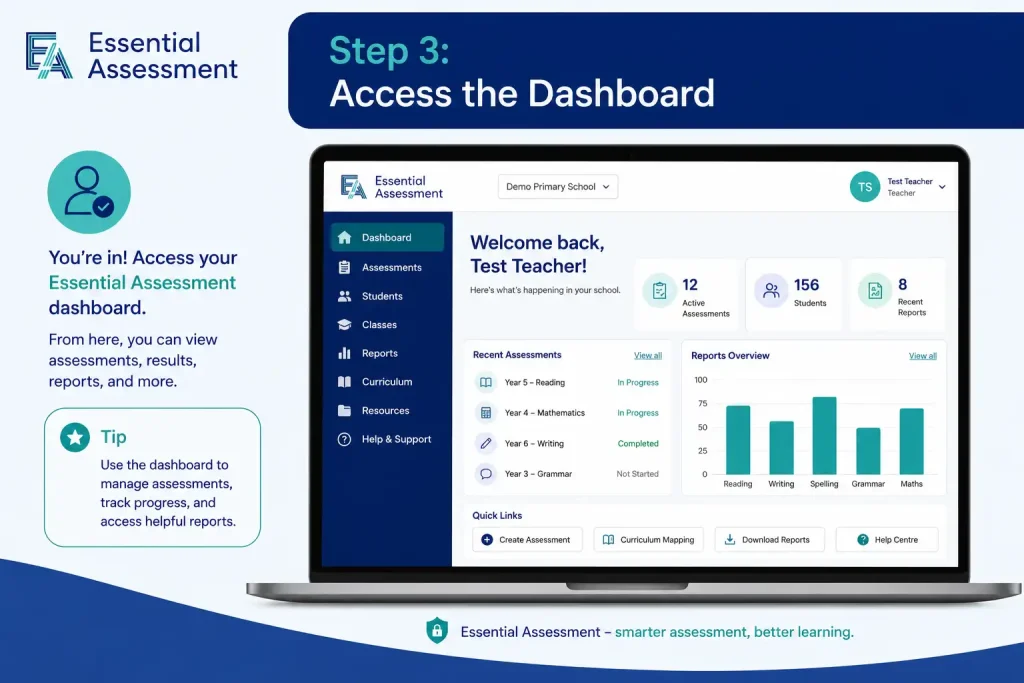
Essential Assessment dashboard displayed after a successful login, showing assessments, reports, classes, and student progress.

After successful authentication, you’ll be taken to your teacher dashboard where you can:

  • Manage classes
  • Assign assessments
  • Review student reports
  • Monitor learning progress
  • Access curriculum resources

Student Login Guide

Students receive their login details directly from their teacher or school.

Step 1: Open the Student Portal

Navigate to the official Essential Assessment Student Portal.

Step 2: Enter Your School Code

Type the school code supplied by your teacher to continue.

Step 3: Choose Your Class

Select the correct class or learning group from the available list.

Step 4: Sign In

Depending on your school’s setup, enter:

  • Student username or name
  • Password or four-digit PIN

Some schools may also support QR code login or Single Sign-On (SSO).

Step 5: Begin Your Assessment

Once logged in, your assigned assessments and learning activities will appear on the dashboard. Simply select an available task and click Start to begin.

Using the Essential Assessment Teacher Dashboard

Explore the Teacher Dashboard

After signing in through the official Teacher/Admin Portal, educators are taken directly to the Teacher Dashboard. This is the main workspace where teachers manage classes, assign assessments, review student performance, and access reporting tools from a single location.Visit Homegage

The dashboard is designed to reduce administrative work by placing the platform’s most frequently used features within easy reach. Rather than moving between different systems, teachers can complete most classroom management tasks from one interface.

Common dashboard functions include:

  • Managing classes and student records
  • Creating and publishing assessments
  • Accessing Mathematics and English resources
  • Viewing completed assessment results
  • Tracking student learning growth
  • Generating curriculum reports
  • Printing student login cards
  • Monitoring personalised learning activities

Whether you’re preparing lessons or reviewing assessment data, the dashboard provides quick access to the tools needed throughout the school year.

Managing Classes in Essential Assessment

Before assigning assessments, teachers should ensure that all classes and student records are correctly organised. Accurate class information helps produce reliable reports and simplifies assessment management.

Create or Open a Class

To begin managing a class:

  • Open the Class Management or Classes section from the dashboard.
  • Select an existing class or create a new teaching group.
  • Confirm the correct year level and class details.
  • Save your changes before continuing.

Keeping class information up to date makes it much easier to assign work, monitor progress, and generate reports later.

Adding Students to Your Class

Essential Assessment offers two convenient ways to enrol students depending on class size.

Method 1: Add Students Individually

Manual entry is suitable when enrolling only a few students or making occasional additions during the school year.

To add a student manually:

  • Open Class Management.
  • Select Add Student.
  • Enter the required information, including:
  • First name
  • Last name
  • Gender (if requested)
  • Year level
  • Save the new student record.

The student will then appear in the class list and can receive future assessment assignments.

Method 2: Import an Entire Class with CSV

Schools managing larger numbers of students often prefer importing records in bulk.

The process involves:

  • Opening the Import Students section.
  • Downloading the official CSV template.
  • Completing all required fields, such as:
  • Student first name
  • Student last name
  • Year level
  • Student ID (where applicable)
  • Uploading the completed CSV file.
  • Reviewing the import summary.
  • Confirming the upload.

Bulk importing saves time, reduces repetitive data entry, and helps maintain consistent student information across the school.

Offical Page

Printing Student Login Cards

Once students have been added successfully, teachers can generate login cards for classroom use.

These printable cards generally contain:

  • School Code
  • Student Name
  • Username (where applicable)
  • Student PIN or Password

Teachers can download the cards as a PDF and distribute them before assessments begin, allowing students to sign in quickly during class.

Creating Assessments in Essential Assessment

One of the platform’s strongest features is its ability to create assessments that align directly with curriculum outcomes. Teachers can assess learning before instruction, during a teaching unit, or after a topic has been completed.

Assessment Types Available

Essential Assessment supports several assessment formats, including:

  • Diagnostic (Pre-Assessment)
  • Formative Assessment
  • Summative (Post-Assessment)
  • Mental Maths
  • Reading and Viewing
  • Writing
  • Grammar and Punctuation
  • Spelling

Each assessment is linked to curriculum standards, making it easier to measure student achievement and identify learning needs.

Assigning an Assessment

Publishing an assessment is a straightforward process that only takes a few steps.

Step 1: Open the Assessments Section

From the Teacher Dashboard, select Assessments to begin creating or assigning a task.

Step 2: Choose the Subject

Select the learning area that matches your lesson.

Mathematics options include:

  • General Mathematics
  • Mental Maths
  • Sunrise Assessment
  • Sunset Assessment

English options include:

  • Reading
  • Writing
  • Grammar
  • Punctuation
  • Spelling

Step 3: Select Students

Assessments can be assigned to:

  • An individual student
  • A single class
  • Multiple classes

This flexibility allows teachers to support different learning groups without creating separate assessments.

Step 4: Configure Assessment Settings

Before publishing, customise the assessment by selecting the appropriate options, such as:

  • Curriculum level
  • Year level
  • Assessment type
  • Opening date
  • Closing date
  • Availability period
  • Student groups

Checking these settings before publishing helps ensure the assessment is delivered to the correct students at the right time.

Step 5: Publish the Assessment

Once everything has been reviewed, select Assign or Publish.

Students will automatically see the assessment in their dashboard when it becomes available.

What Students Experience During an Assessment

The student interface has been designed to keep the assessment process clear and distraction-free.

My Tasks Dashboard

After signing in, students are presented with a list of assessments assigned by their teacher. Selecting a task opens the assessment when it is available.

Starting an Assessment

Choosing Start Test launches the assessment.

Depending on teacher settings, students may encounter:

  • Multiple-choice questions
  • Drag-and-drop activities
  • Short-answer responses
  • Written text-entry questions

Some assessments may also include a countdown timer.

Answering Questions

Students usually progress through questions at their own pace unless time restrictions have been enabled.

Many assessments also allow students to:

  • Return to previous questions
  • Review earlier responses
  • Flag questions for later review before submitting

Submitting Completed Work

After answering every question, students submit the assessment for marking.

The platform processes responses automatically, allowing teachers to access assessment results soon after submission without manual marking.

Personalised Learning Recommendations

Following diagnostic assessments, Essential Assessment creates personalised learning pathways based on each student’s results.

Rather than assigning identical activities to every learner, the platform recommends targeted practice that focuses on areas requiring additional improvement. This personalised approach helps strengthen individual skills while supporting differentiated teaching strategies across the classroom.

Understanding Assessment Reports

Assessment data becomes more valuable when it is presented in a clear and meaningful way. Essential Assessment includes several built-in reports that help teachers evaluate learning progress at both individual and class levels.

Diagnostic Report

The Diagnostic Report provides detailed information about each student’s current understanding.

Teachers can identify:

  • Learning strengths
  • Curriculum gaps
  • Areas needing intervention
  • Common misconceptions

This report is particularly useful when planning future lessons.

Growth Report

The Growth Report compares assessment results over time, allowing teachers to measure progress between pre-assessment and post-assessment activities.

It helps evaluate:

  • Student improvement
  • Learning growth
  • Curriculum progress
  • Overall achievement

Many schools use this report to measure the effectiveness of classroom instruction.

Curriculum Achievement Report

This report aligns assessment results with both the Australian Curriculum and the Victorian Curriculum, helping teachers monitor progress against expected learning standards and support evidence-based reporting.

Class Summary Report

The Class Summary Report provides a whole-class overview using visual summaries and performance indicators.

Teachers can quickly identify trends across the class, recognise concepts that require additional teaching, and make informed decisions when planning future lessons.

Troubleshooting Essential Assessment Login Issues

Although Essential Assessment is designed to provide reliable access for teachers and students, occasional login or assessment problems can occur. Most issues are easy to resolve by checking login credentials, browser settings, or assessment availability before contacting support.

Common Login Problems and How to Fix Them

IssuePossible ReasonRecommended Solution
Student cannot sign inIncorrect School Code, class selection, or PINCheck the login details supplied by the teacher and, if necessary, print a new student login card.
Teacher cannot access accountForgotten or incorrect passwordSelect Forgot Password on the login page and follow the password reset instructions.
Assigned assessment is missingAssessment has not been published or is outside the available date rangeConfirm that the assessment has been assigned to the correct class and that the opening and closing dates are active.
Assessment stops respondingTemporary browser or internet issueRefresh the page, verify your internet connection, and use a supported web browser. Completed responses are generally saved automatically.
Images or audio fail to loadBrowser extensions or school network restrictionsDisable ad blockers, update your browser, and ask your school’s IT team to check network filtering if the problem continues.

Resetting Your Teacher or Administrator Password

If you’ve forgotten your login password, you can create a new one through the official Teacher/Admin sign-in page.

Follow These Steps

  • Open the Teacher/Admin login page.
  • Select Forgot Password.
  • Enter your registered school email address.
  • Submit the request.
  • Open the password reset email.
  • Click the secure reset link.
  • Create a new password and sign back into your account.

If the email doesn’t arrive after a few minutes, check your spam or junk folder before contacting your school’s administrator for further assistance.

Browser and Device Recommendations

Using a modern browser helps ensure assessments, reports, and interactive content work as expected.

Recommended Browsers

  • Google Chrome
  • Microsoft Edge
  • Apple Safari
  • Mozilla Firefox (latest version)

Running the latest browser version improves compatibility, security, and overall performance.

Tips for Teachers to Get the Best Results

Essential Assessment delivers the greatest value when assessment data is used to guide teaching decisions rather than simply record student scores.

Begin Each Unit with Diagnostic Assessments

Starting with a diagnostic assessment provides a clear picture of what students already know and highlights misconceptions before new learning begins.

Review Reports Frequently

Growth reports and curriculum reports provide valuable evidence that can be used to adjust lesson plans, identify students needing extra support, and monitor learning progress throughout the term.

Keep Class Records Accurate

Review student enrolments regularly and remove inactive records when required. Accurate class information leads to more reliable reporting.

Set Appropriate Assessment Dates

Choose realistic opening and closing dates that give students enough time to complete assessments while keeping learning activities on schedule.

Encourage Personalised Practice

After diagnostic assessments, use the recommended learning pathways to help students strengthen skills that need further development while reinforcing existing knowledge.

Why Many Australian Schools Use Essential Assessment

Essential Assessment continues to be a popular assessment solution because it combines curriculum-aligned testing, automatic reporting, and personalised learning within a single platform.

Some of its key advantages include:

  • Curriculum-aligned Mathematics and English assessments
  • Automatic marking for supported assessment types
  • Immediate access to student performance data
  • Personalised learning recommendations
  • Long-term growth tracking
  • Detailed curriculum reporting
  • Class-wide performance summaries
  • Secure access for teachers, administrators, and students

These features help reduce administrative workload while giving educators meaningful information that supports evidence-based teaching.

Getting Help with Essential Assessment

If you’re unable to resolve a technical issue through your school or the login page, contact the official Essential Assessment support team.

Support Channels

  • Official website
  • Teacher and Administrator login portal
  • Student portal
  • Support email
  • Australian telephone support during standard business hours

Using official support services ensures you receive accurate assistance with account access, assessments, technical issues, and platform updates.

FAQs

Essential Assessment encourages a growth mindset by helping students evaluate their progress, set meaningful learning goals, and benefit from constructive feedback. These practices align with Carol Dweck’s research, building resilience and motivating learners to overcome challenges with confidence and persistence.

Here is a completely rewritten version of your paragraph. It preserves the original meaning while using fresh wording, improved flow, and better readability, matching your uploaded rewriting instructions for multiple paragraphs rather than expanding into a full article.

Assessment is built on five essential principles that help ensure evaluations are fair, meaningful, and effective. These principles—validity, reliability, practicality, authenticity, and washback—provide a strong framework for measuring student achievement while also supporting better teaching and learning outcomes.

  • Validity ensures that an assessment accurately measures the knowledge, skills, or abilities it is designed to evaluate, allowing results to reflect true student performance.
  • Reliability means that an assessment produces consistent and dependable results when administered under similar conditions, giving educators confidence in the scores.
  • Practicality focuses on the feasibility of an assessment. A practical test is cost-effective, straightforward to administer, easy to score, and can be completed within a reasonable timeframe.
  • Authenticity refers to the use of realistic tasks that mirror real-world situations. Authentic assessments encourage learners to apply their knowledge in meaningful contexts rather than simply recalling information.
  • Washback describes the influence that assessment has on teaching practices and student learning. Positive washback motivates effective study habits, encourages high-quality instruction, and promotes deeper understanding instead of memorisation.

When these five principles are applied together, assessments become more than tools for assigning grades. They provide accurate evidence of learning, encourage continuous improvement, and create a fair, engaging, and supportive educational experience for both students and teachers.

Here is a fully rewritten version of your content with improved readability, natural flow, and original wording while preserving the original meaning. It follows the guidance in your uploaded rewriting prompt for rewriting multiple paragraphs without expanding them into a full article.

Essential questions are broad, thought-provoking questions that encourage students to think deeply rather than search for one correct answer. They explore the central ideas of a subject, inspire curiosity, and support continuous learning by prompting learners to reflect, investigate, and develop their understanding over time.

Characteristics of Essential Questions

  • Open-ended: These questions cannot be answered with a simple “yes,” “no,” or a single fact. Instead, they invite discussion, interpretation, and multiple perspectives.
  • Thought-provoking: They challenge learners to analyse information, evaluate evidence, solve problems, and make meaningful connections between concepts.
  • Ongoing and reusable: Essential questions remain relevant throughout a unit or course. As students gain new knowledge and experiences, they revisit these questions and often develop deeper or more sophisticated answers.

Examples of Essential Questions Across Subjects

  • Science: How do structure and function work together in living organisms?
  • History: Could the Civil War have been prevented?
  • Literature: What does it truly mean to belong?

By placing these kinds of questions at the centre of learning, teachers encourage inquiry, critical thinking, and meaningful classroom discussions. Rather than focusing solely on memorising facts, students are guided to explore complex ideas, consider different viewpoints, and build a deeper understanding of the subject matter.

Here’s a completely rewritten version with improved readability, natural flow, and SEO-friendly language:

Understanding Essential Assessment Scores

The highest score a student can achieve in Essential Assessment is 100%, which means every assessed question has been answered correctly. While the platform records raw percentages, its primary purpose is to measure student learning progress and curriculum achievement rather than assign traditional grades.

Instead of focusing solely on a final mark, Essential Assessment evaluates whether students have successfully demonstrated each curriculum content descriptor. A score of 66% or higher is considered the benchmark for demonstrating mastery of a learning outcome.

Essential Assessment Achievement Levels

Achievement LevelScoreDescription
Demonstrated (Green)66%–100%The student has met the required learning standard and demonstrated understanding of the assessed concept.
Partially Demonstrated (Yellow)1%–65%The student has shown some understanding but has not yet reached the expected level of proficiency.
Not Yet Demonstrated (Red)0%The student has not demonstrated the required knowledge or skill for the assessed content.
Not Assessed (White)N/AThis curriculum content was not included in the assessment.

Essential Assessment Score Breakdown

  • Maximum possible score: 100%
  • Demonstrated benchmark: 66% or above
  • Partial achievement: 1% to 65%
  • Not demonstrated: 0%

How Essential Assessment Measures Success

Essential Assessment is designed to help teachers understand how students are progressing over time rather than simply recording a final percentage. It uses assessment data to identify learning strengths and areas that need additional support.

Teachers typically use the platform to:

  • Conduct pre-assessments to identify existing knowledge and learning gaps.
  • Compare post-assessment results to measure student improvement.
  • Track mastery of individual curriculum outcomes using colour-coded achievement levels.
  • Plan targeted instruction based on each student’s performance.

By focusing on curriculum mastery instead of traditional grading, Essential Assessment provides meaningful insights that help teachers personalise learning and support continuous student growth.

Here’s a fresh, human-written rewrite that keeps the original meaning while improving clarity and readability.

Is Essential Assessment Based on Evidence-Based Research?

Yes, Essential Assessment is an evidence-based educational platform designed to improve teaching, assessment, and student learning. It incorporates established educational research, curriculum-aligned assessment practices, and cognitive science principles to help teachers make informed instructional decisions and support student achievement.

Why Essential Assessment Is Evidence-Based

Essential Assessment combines educational research with practical classroom tools to ensure assessments provide meaningful insights rather than just test scores. Its features are designed to help teachers identify learning needs, monitor progress, and deliver targeted instruction.

Curriculum-Aligned Assessments

Every assessment is mapped directly to official curriculum standards. This allows teachers to accurately measure how well students have mastered specific learning outcomes and identify the areas that require further development.

Cognitive Science Principles

The platform incorporates proven learning strategies drawn from cognitive science, including:

  • Retrieval practice to strengthen long-term memory.
  • Cognitive load management to make learning more effective.
  • Regular review and reinforcement to improve knowledge retention.

These approaches help students build a deeper understanding of mathematical and English concepts.

Targeted Teaching Support

Assessment data highlights each student’s strengths and learning gaps. Teachers can use these insights to plan focused lessons, provide additional support where needed, and differentiate instruction based on individual learning needs.

Continuous Formative Assessment

Rather than relying solely on end-of-term tests, Essential Assessment supports ongoing formative assessment. Teachers can regularly monitor student progress, evaluate growth over time, and adjust teaching strategies as learning develops.

Benefits for Teachers and Students

Essential Assessment helps create a more personalised learning experience by enabling educators to:

  • Monitor student progress throughout the school year.
  • Identify misconceptions before they become larger learning barriers.
  • Deliver targeted interventions for individual students or groups.
  • Track curriculum achievement using clear, data-driven reports.
  • Support continuous improvement through regular assessment and feedback.

What Is the Primary Purpose of Assessment?

The primary purpose of assessment is to collect accurate information about a learner’s current knowledge, understanding, and skills. This information helps educators measure student achievement, make informed teaching decisions, and provide meaningful feedback that supports continuous learning and improvement.

Rather than serving only as a grading tool, assessment plays a vital role throughout the learning process. It enables teachers to identify what students already understand, where they are experiencing difficulties, and what additional support they need to succeed.

Main Purposes of Assessment

Monitor Student Progress

Assessment helps teachers evaluate how well students are learning throughout a course or program. By regularly checking understanding, educators can identify strengths, recognise learning gaps, and monitor academic growth over time.

Improve Teaching Strategies

Assessment results provide valuable insights into classroom performance. Teachers can use this information to adjust lesson plans, choose more effective teaching methods, and provide targeted instruction that meets the needs of individual learners.

Provide Meaningful Feedback

Constructive feedback is one of the most important outcomes of assessment. It helps students understand what they are doing well, identifies areas for improvement, and encourages them to take an active role in their own learning.

Measure Learning Outcomes

At the end of a unit, semester, or course, assessment determines whether students have achieved the intended learning objectives. These results are commonly used to evaluate overall performance and readiness for the next stage of education.

Support Grading and Certification

Summative assessments provide evidence of student achievement by assigning grades, scores, or qualifications. These results help schools, colleges, and employers evaluate the knowledge and skills learners have developed.

Why Assessment Matters

Effective assessment benefits both students and teachers by creating a clear picture of learning progress. It supports informed decision-making, encourages continuous improvement, and ensures that instruction is aligned with educational goals.

Key benefits include:

  • Identifying students’ current level of understanding.
  • Detecting learning gaps before they become larger challenges.
  • Personalising instruction to meet individual learning needs.
  • Measuring progress throughout the learning journey.
  • Providing reliable evidence for grading and reporting.
  • Encouraging students to reflect on and improve their performance.

When used effectively, assessment becomes more than a method of measuring achievement—it is a powerful tool for enhancing teaching, supporting student success, and promoting lifelong learning.

What Is the 70/30 Rule in Teaching?

The 70/30 rule in teaching is an instructional guideline that encourages a student-centred classroom. It suggests that students should spend around 70% of the lesson actively participating, while the teacher uses the remaining 30% for direct instruction, explanations, and guidance.

Instead of relying on long lectures, this approach gives students more opportunities to discuss ideas, solve problems, collaborate with classmates, and apply what they have learned. The goal is to increase engagement and improve long-term understanding through active participation.

Key Principles of the 70/30 Rule

Student-Centred Learning

The 70/30 rule shifts the focus from teacher-led instruction to student involvement. During most of the lesson, learners are encouraged to ask questions, complete activities, participate in discussions, and practise new skills independently or in groups.

Balanced Classroom Time

Teachers aim to spend about 30% of class time introducing concepts, explaining difficult topics, and providing instructions. The remaining 70% is dedicated to meaningful learning activities that allow students to explore and apply their knowledge.

Planning for Active Learning

The principle also influences lesson planning. Many educators devote 70% of their preparation time to designing interactive activities, practical exercises, and collaborative tasks, while spending 30% reviewing the content they will teach. This balance helps create lessons that are engaging and learner-focused.

Benefits of the 70/30 Teaching Approach

Greater Student Engagement

Students remain more attentive when they actively contribute to lessons instead of listening passively for long periods. Frequent participation encourages curiosity, discussion, and deeper involvement in learning.

Stronger Understanding and Retention

Learning by doing helps students remember information more effectively. Regular practice, problem-solving, and discussion strengthen understanding and improve long-term retention.

Improved Confidence

When students are given more opportunities to speak, explain their thinking, and complete tasks independently, they become more confident in applying new knowledge and skills.

Better Opportunities for Feedback

As students work through activities, teachers can observe their progress, identify misconceptions, and provide immediate, personalised feedback to support learning.

Why the 70/30 Rule Matters

The 70/30 rule promotes a classroom where students become active participants rather than passive listeners. By reducing lecture time and increasing opportunities for discussion, collaboration, and hands-on learning, teachers can create a more engaging environment that supports deeper understanding, stronger critical-thinking skills, and improved academic outcomes.

Here’s a rewritten version with improved readability and a more natural flow:

Assessment supports learning by giving students clear information about their progress and helping them understand what they need to improve. Instead of simply measuring performance, effective assessments encourage continuous growth by identifying strengths, highlighting areas for development, and guiding learners toward their academic goals.

How Assessments Help Learners

  • Provide Constructive Feedback: Assessments offer valuable feedback that helps students recognise their strengths, address weaknesses, and improve future performance.
  • Support Learning Goals: Assessment results help learners understand their current level of achievement and identify the steps needed to reach their educational objectives.
  • Encourage Continuous Progress: Regular assessment motivates students to stay engaged with their learning, celebrate improvements, and keep working towards higher levels of achievement.
  • Build Self-Reflection Skills: By reviewing their results, learners become more aware of their own progress and can take greater responsibility for improving their knowledge and skills.

When used effectively, assessments become more than a way to measure learning—they provide ongoing guidance, build confidence, and help students make steady progress throughout their educational journey.

What Are the 7 Principles of Effective Educational Assessment?

Effective educational assessment is built on seven key principles that ensure assessments are accurate, fair, and meaningful. These principles help educators evaluate student learning consistently while providing valuable information that supports both teaching and academic improvement.

The Seven Principles of Assessment

1. Validity

An assessment should measure exactly what it is designed to assess. Tasks, questions, and activities must accurately evaluate the intended knowledge, skills, or learning outcomes without testing unrelated abilities.

2. Reliability

Assessment results should be consistent and dependable. If the same assessment is administered under similar conditions, it should produce comparable outcomes, ensuring that student performance is measured fairly.

3. Fairness

Every learner should have an equal opportunity to demonstrate their knowledge and skills. Assessments should be free from bias, accessible to all students, and designed to accommodate diverse backgrounds and learning needs.

4. Flexibility

Effective assessments recognise that students learn in different ways. Where appropriate, reasonable adjustments or alternative assessment methods can be provided to support diverse learners while maintaining the required academic standards.

5. Transparency

Students should clearly understand what is expected of them before completing an assessment. Learning objectives, marking criteria, grading standards, and submission requirements should be communicated openly so learners know how their work will be evaluated.

6. Alignment

Assessment activities should directly support the curriculum and learning objectives. Every task should reflect what has been taught in class and measure the knowledge and skills that students are expected to develop.

7. Usefulness

Assessment should provide meaningful information that benefits both teachers and students. Results and feedback should identify strengths, highlight areas for improvement, and guide future teaching strategies and learning plans.

Why These Principles Matter

Applying these seven principles helps create assessments that are accurate, consistent, and learner-focused. They improve the quality of teaching by providing reliable evidence of student achievement while ensuring that every learner is assessed fairly and transparently.

When assessment is valid, reliable, fair, flexible, transparent, aligned, and useful, it becomes more than a method of measuring performance—it becomes a valuable tool for supporting continuous learning, improving instruction, and helping students achieve their educational goals.

Here’s a rewritten version with a natural flow and improved readability:

Assessment theory provides the foundation for creating meaningful and effective assessments. Just as strong teaching relies on educational knowledge, high-quality assessment depends on understanding the principles that guide its design and use. These principles are commonly known as the four pillars of effective assessment: purpose, validity, reliability, and value.

The Four Pillars of Effective Assessment

1. Purpose

Every assessment should have a clear purpose before it is created. Whether the goal is to measure student understanding, monitor progress, diagnose learning gaps, or evaluate achievement, the assessment must be designed to meet that specific objective.

2. Validity

Validity ensures that an assessment measures the knowledge, skills, or learning outcomes it is intended to assess. A valid assessment focuses on the correct content and provides an accurate picture of student performance without being influenced by unrelated factors.

3. Reliability

Reliability refers to the consistency of assessment results. Students completing the same assessment under similar conditions should receive dependable and comparable outcomes. Reliable assessments help educators make fair and informed decisions based on accurate evidence.

4. Value

An assessment should provide meaningful information that supports learning. Beyond assigning grades, valuable assessments generate useful feedback, highlight strengths and areas for improvement, and help teachers plan future instruction while guiding students towards better learning outcomes.

Why These Four Pillars Matter

When assessments are built around purpose, validity, reliability, and value, they become more than a way to measure achievement. They provide trustworthy evidence of learning, support effective teaching, encourage student growth, and ensure assessment results can be used confidently to improve educational outcomes.

Final Thoughts

Essential Assessment gives Australian schools a practical way to combine assessment, reporting, and personalised learning within one digital platform. Teachers can create curriculum-aligned assessments, monitor student achievement, and use detailed reports to plan future instruction, while students benefit from targeted learning activities based on their individual progress.

To ensure a smooth experience, always use the official login portal, keep your account details current, and review assessment reports regularly. Staying connected through the official platform also ensures you receive the latest feature updates, curriculum improvements, and support resources as they become available.

Read More:
Working With Children Check Australia (WWCC): Complete Online Guide 2026

Storypark Login Made Simple: The Complete Access Guide for Families (2026)
Student Portal Navigator: The Ultimate Campus Access Guide (2026)
Passport Application Guide (2026): Complete Online Process & Requirements

Leave a Comment

Your email address will not be published. Required fields are marked *

Scroll to Top