I’ll build the article in 3 parts, using the supplied dynamic SEO prompt as the writing framework and current Australian Department of Home Affairs information as the factual reference. I’ll keep “Visitor Visa Subclass 600” / “Visa 600” prominent but natural rather than forcing an unnatural keyword density, in line with the prompt’s anti-keyword-stuffing rule.
If you are planning a holiday in Australia, visiting relatives, attending certain business activities or taking a cruise, the Visitor Visa Subclass 600 may be one of the visa options to consider. The visa is designed for temporary visitors, but the requirements differ depending on the stream you apply for and whether you are inside or outside Australia.
The Australian Department of Home Affairs currently describes Subclass 600 as a visitor visa for tourists, business visitors and people visiting family, with stay periods that can be 3, 6 or 12 months depending on the circumstances. Applicants must generally be genuine visitors and have enough money to support themselves and leave Australia. (Immigration and citizenship Website)
Fore More Information:
Visit Homepage
What Is the Australian Visitor Visa Subclass 600?
The Visitor Visa Subclass 600 allows eligible people to travel to Australia temporarily for permitted visitor activities. Depending on the stream, this can include tourism, visiting family and friends, cruising and limited business visitor activities.
It is important to understand that a Visitor Visa 600 is not a general work visa. A business visitor may undertake permitted activities such as attending meetings, negotiating contracts or participating in certain conferences, but this does not give permission to work for an Australian business or provide services to the Australian public. (Immigration and citizenship Website)
For tourism applications made outside Australia, the Department states that applicants must be outside Australia both when they apply and when the visa application is decided. The Tourist stream can allow a stay of up to 12 months, depending on the visa granted. (Immigration and citizenship Website)
Visitor Visa 600 Streams at a Glance
| Stream | Typical purpose | Where you apply |
|---|---|---|
| Tourist stream | Holidays, cruises and visiting family or friends | Outside Australia |
| Tourist stream | Tourism or family visits in Australia | In Australia |
| Business Visitor stream | Permitted short business visitor activities | Outside Australia |
| Sponsored Family stream | Visiting eligible family members with sponsorship | Outside Australia |
| Approved Destination Status stream | Approved organised tour arrangements for eligible visitors | Outside Australia |
| Frequent Traveller stream | Frequent visits for eligible applicants | Outside Australia |
The stay period, entry arrangements and conditions depend on the particular stream and the decision made on the application. Therefore, don’t assume that every Visa 600 applicant receives the same travel period or conditions.
Fore More Information:
Visit Homepage
Choosing the Right Visa 600 Stream
Choosing the correct stream is one of the first decisions you need to make. Your reason for travelling should match the stream you select.
1. Tourist Stream
The Tourist stream is intended for people travelling to Australia for tourism, visiting family or friends, or taking a cruise. The Department currently states that this stream can permit a stay of up to 12 months. (Immigration and citizenship Website)
You must demonstrate that you genuinely intend to visit Australia temporarily, have adequate funds for your stay and comply with the visa requirements.
If you are applying from outside Australia, you must remain outside Australia when the application is made and when it is decided. (Immigration and citizenship Website)
2. Business Visitor Stream
The Business Visitor stream is different from a work visa. Permitted activities can include making general business or employment enquiries, investigating or negotiating a business contract, participating in an official government visit, or attending a conference, trade fair or seminar where you are not paid by the organiser. Tourism activities may also be undertaken. (Immigration and citizenship Website)
However, the stream does not permit you to work for an Australian business or organisation or sell goods or services directly to the public. (Immigration and citizenship Website)
3. Sponsored Family Stream
This stream is intended for eligible people visiting family members in Australia where sponsorship requirements apply.
The Department’s sponsorship material states that a sponsor must generally be an Australian citizen or permanent resident aged 18 or over and settled in Australia, with specific family relationship requirements applying to family sponsorship. (Immigration and citizenship Website)
A sponsorship arrangement does not mean that the visitor can work in Australia. Sponsored Family stream visitors are not permitted to work. (Immigration and citizenship Website)
4. Other Visa 600 Streams
The Visitor Visa Subclass 600 also includes specialised arrangements such as the Approved Destination Status stream and Frequent Traveller stream. These have their own eligibility requirements, so applicants should use the Department of Home Affairs page for the specific stream rather than relying on general Tourist stream requirements.
Who Can Apply for Visa 600?
The exact eligibility rules depend on the stream, but there are several principles that apply when assessing a visitor application.
Genuine Temporary Visitor Intention
One of the most important considerations is whether you genuinely intend to visit Australia for the purpose stated in your application.
For example, a tourist application should clearly demonstrate a temporary holiday or family visit rather than an intention to undertake unauthorised work.
Evidence that explains your circumstances can help the Department assess your application. This may include employment information, study commitments, family circumstances, financial evidence and your proposed travel arrangements.
Enough Money for Your Stay
You need to demonstrate that you have sufficient funds to support yourself during your visit and meet your travel expenses.
The Department specifically lists having enough money for your stay as a basic eligibility requirement for the Visitor Visa Subclass 600. (Immigration and citizenship Website)
Financial evidence should therefore make sense in relation to your proposed trip. A bank statement by itself may not explain where funds came from, so supporting evidence such as employment or income documents can be useful where relevant.
Health and Character Requirements
Some applicants may need to complete health examinations or provide character-related documents. The Department can request additional information depending on the circumstances of the application.
Don’t assume that every applicant will have exactly the same checklist. The required evidence can vary according to your circumstances, nationality, stream and the information requested by the Department.
Australian Government Debts
If you have outstanding debts to the Australian Government, this can affect your visa situation. Applicants should address relevant government debts rather than overlooking them during the application process.
Applicants Under 18
Additional requirements can apply to applicants under 18. Parents, guardians and other people responsible for a young visitor may need to provide additional documentation concerning consent and accommodation arrangements.
The exact requirements should be checked against the Department’s instructions for the applicant’s circumstances.
Documents You Should Prepare for Visa 600
There isn’t one universal document list that applies identically to every Subclass 600 application. Your ImmiAccount application and the Department’s instructions determine what evidence is required.
Nevertheless, preparing your core documents before starting can make the application process much easier.
Identity Documents
Common identity evidence may include:
- Current passport
- Passport biodata page
- National identity document, where applicable
- Birth certificate, where relevant
- Evidence of a legal name change, if applicable
- Other identity documents requested by the Department
For documents that aren’t in English, translation requirements need to be considered. The Department’s Tourist stream instructions state that non-English documents should be translated into English and that both the original and translated documents should be provided. (Immigration and citizenship Website)
Financial Evidence
Depending on your circumstances, you may provide evidence such as:
- Recent bank statements
- Evidence of regular income
- Payslips
- Tax documents
- Business records
- Evidence of financial support from another person, where relevant
The purpose is to help establish that you can financially support the proposed visit.
Evidence of Your Travel Purpose
Your supporting documents should match the reason for travelling.
For example, a tourist may provide a proposed itinerary and accommodation details, while someone visiting family may include information about the person they intend to visit.
Business visitors should provide relevant information about their proposed business activities and Australian contacts where appropriate.
Employment or Study Evidence
Evidence of your commitments outside Australia can help explain your circumstances.
Depending on your situation, this could include:
- Employer confirmation
- Approved leave information
- Employment contract
- Business ownership documents
- Student enrolment evidence
- Other evidence showing your ongoing commitments
The important point is consistency. Your employment, finances, travel purpose and proposed length of stay should tell a coherent story.
Before You Submit: A Useful Document Check
Use this simple preparation list before moving into the online application:
Identity
- ☐ Passport is valid
- ☐ Personal details are consistent
- ☐ Name-change evidence is included if applicable
Money
- ☐ Recent financial evidence is available
- ☐ Income source can be explained
- ☐ Funds are reasonable for the proposed trip
Travel
- ☐ Purpose of the visit is clearly explained
- ☐ Proposed itinerary is available
- ☐ Accommodation or invitation information is included where relevant
Personal circumstances
- ☐ Employment or study evidence is available
- ☐ Relevant family circumstances are explained
- ☐ Previous travel or visa information is accurate
Translations
- ☐ Non-English documents have been translated where required
- ☐ Original documents are retained and supplied as required
The Department advises applicants to scan or photograph documents clearly and legibly. Where a document has multiple pages, the pages should be saved together as one file. (Immigration and citizenship Website)
Fore More Information:
Visit Homepage
How to Apply for Visa 600 Online
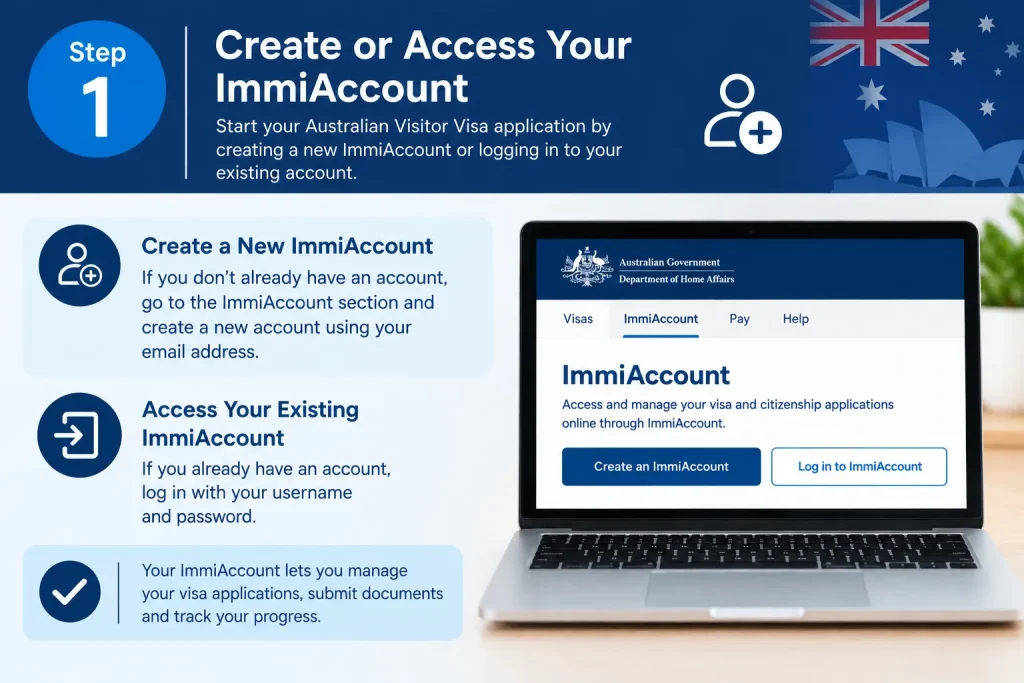
Once you have identified the correct Visitor Visa Subclass 600 stream and gathered your evidence, the application is generally completed online through ImmiAccount. The Department of Home Affairs says ImmiAccount can be used to apply for visas, attach documents, manage applications and respond to requests for further information. (Immigration and citizenship Website)
Step 1: Create or Access Your ImmiAccount
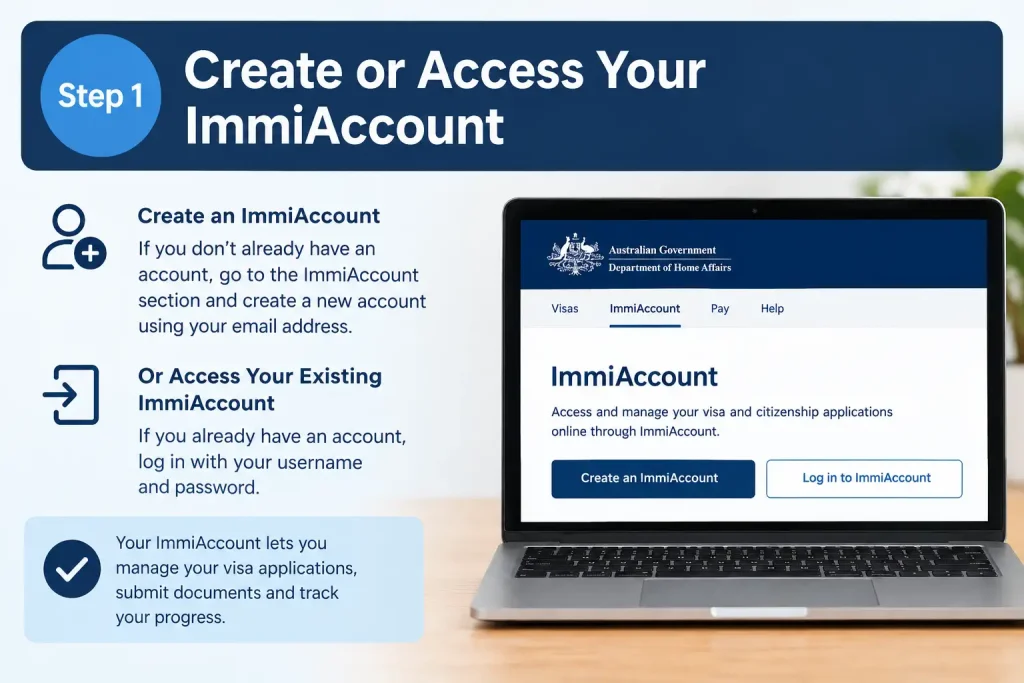
Start by opening the official Department of Home Affairs website and accessing ImmiAccount.
If you already have an account, sign in using your existing details. New applicants can create an account and then begin the relevant visa application.
Before starting, make sure you have access to the email address associated with your application. Keep your account details secure because important correspondence about your Visa 600 application may be delivered through the online system.
Step 2: Select the Appropriate Subclass 600 Stream
Don’t select a stream simply because another traveller used it.
Your application should reflect your actual reason for visiting Australia. For example:
- Tourism or visiting friends and relatives → Tourist stream
- Permitted short-term business activities → Business Visitor stream
- Visiting eligible family under a sponsorship arrangement → Sponsored Family stream
- Eligible organised tour arrangements → Approved Destination Status stream
- Frequent travel under the relevant programme → Frequent Traveller stream
For an offshore Tourist stream application, the Department states that you must be outside Australia both when you apply and when the application is decided. (Immigration and citizenship Website)
Step 3: Complete the Online Application Carefully
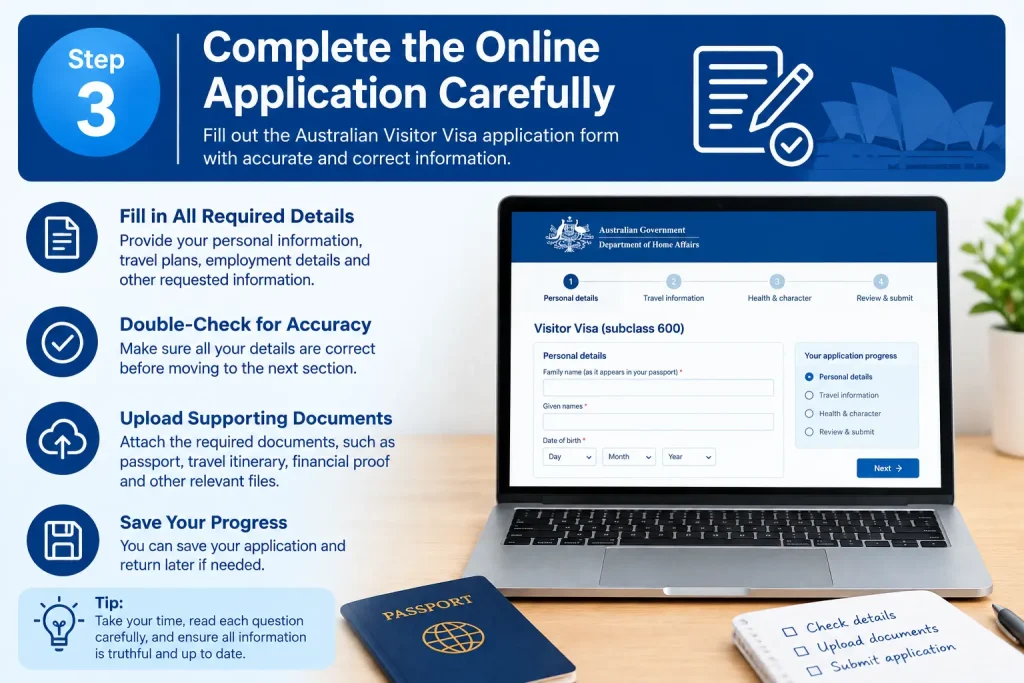
The application asks for information about your identity, travel plans, personal circumstances and supporting evidence.
Take your time with each section. Information should be accurate and consistent with your documents.
You may need to provide information relating to:
- Passport and identity
- Contact details
- Current residence
- Employment or study
- Previous travel
- Family circumstances
- Proposed Australian visit
- Financial circumstances
- Previous visa applications
- Criminal or character matters, where applicable
A small error in a name, passport number, date or previous travel history can create unnecessary complications.
Step 4: Upload Your Supporting Documents
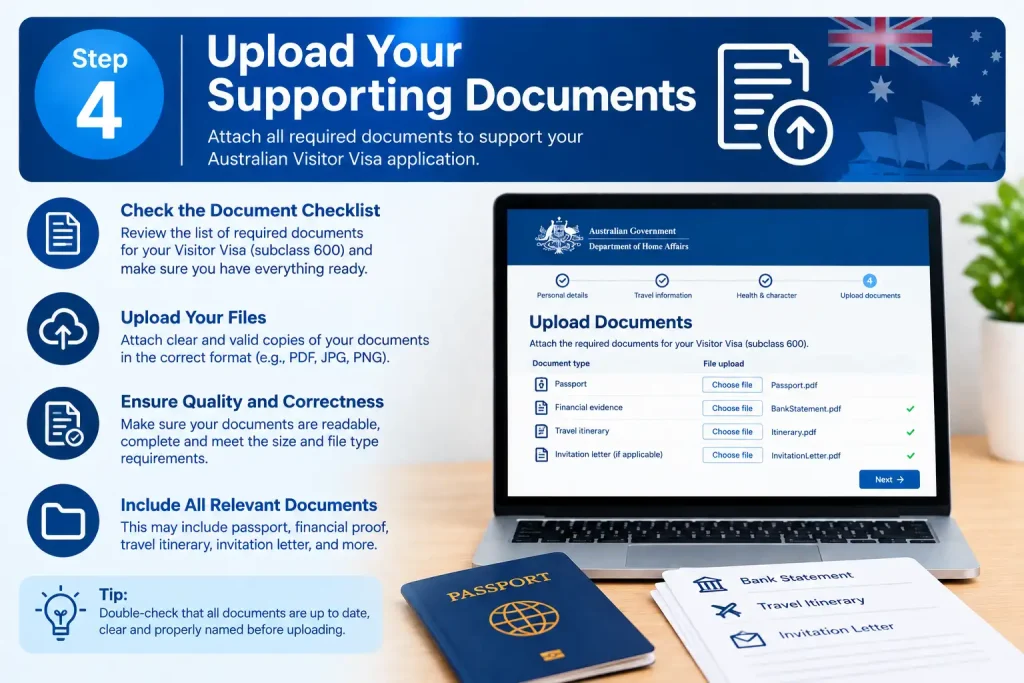
After completing the relevant sections, attach your supporting evidence through ImmiAccount.
For an offshore Tourist stream application, the Department recommends providing information that supports the purpose of the visit and demonstrates reasons to return home. Examples include an employer letter confirming that you intend to return to your job, evidence of study, immediate family connections or evidence of assets in your home country. (Immigration and citizenship Website)
Your documents might include:
Identity Evidence
- Passport
- Birth certificate, where relevant
- National identity documents
- Evidence of name changes
Financial Evidence
- Bank statements
- Income evidence
- Payslips
- Tax documents
- Business records, where applicable
Evidence of Your Circumstances
- Employer letter
- Approved leave
- University or college enrolment
- Business ownership evidence
- Family information
- Property or other significant asset evidence, where relevant
Evidence of the Visit
- Proposed itinerary
- Accommodation details
- Information about family or friends you intend to visit
- Relevant invitation information
Don’t upload documents simply to make the application look larger. Each document should have a purpose and support information contained in your application.
How Should Documents Be Prepared?
The Department provides specific instructions for document preparation.
If your documents are not in English, arrange English translations and provide the original and translated documents as required. Translation requirements differ depending on whether the translation was completed in Australia or overseas. (Immigration and citizenship Website)
Scans and photographs should be:
- Clear
- Legible
- In colour
- Complete
- Saved appropriately when a document has multiple pages
For a multi-page document, the Department advises saving the pages together as one file. (Immigration and citizenship Website)
Important Tip
Don’t wait until after submitting your Visa 600 application to organise basic evidence if you already know it will be required. The Department says submitting all necessary supporting documents with the application can help avoid delays. (Immigration and citizenship Website)
Step 5: Pay the Visa Application Charge
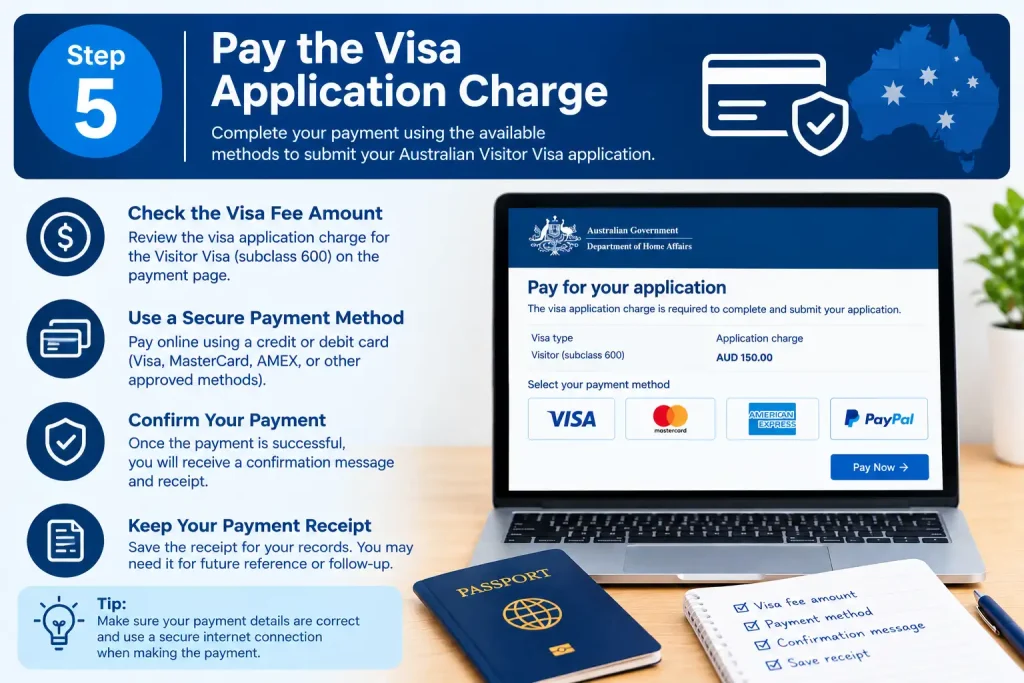
Before the application can be processed, you need to pay the applicable Visa Application Charge (VAC).
The exact amount depends on factors such as the visa, application circumstances and where the application is made. The Department’s current pricing information should be checked immediately before submission because visa costs can change. (Immigration and citizenship Website)
Australian Visa Pricing Estimator
The Department’s pricing estimator asks questions including:
- Visa subclass and stream
- Passport country
- Intended lodging date
- Whether you apply online
- Whether the applicant is in Australia
- Number of additional applicants
- Certain previous temporary visa circumstances
Do not rely on an old Visa 600 fee quoted on another website. The Department specifically states that visa costs change and recommends using its current pricing information. (Immigration and citizenship Website)
There can also be additional expenses, such as:
- Biometrics
- Health examinations
- Police certificates
- Translation costs
- Other document-related expenses
These are separate from the basic visa application charge. (Immigration and citizenship Website)
Step 6: Review and Submit Your Visa 600 Application
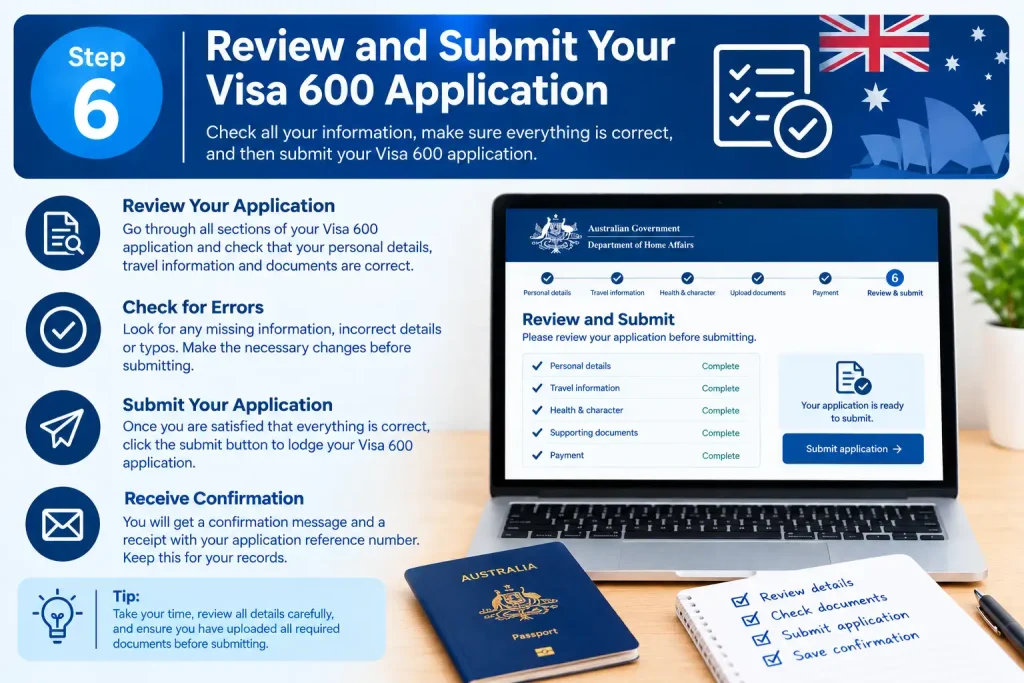
Before pressing submit, perform one final review.
Final Submission Checklist
| Area | What to check |
|---|---|
| Identity | Passport and personal details are correct |
| Stream | Your selected stream matches your travel purpose |
| Travel | Dates and plans are realistic and consistent |
| Finance | Evidence supports your ability to fund the visit |
| Employment | Work or study information is accurate |
| Documents | Required evidence has been uploaded |
| Translations | Non-English documents have appropriate translations |
| Payment | Correct application charge has been paid |
| Declarations | All answers and declarations are truthful |
Once submitted, retain your application details and transaction information for your records.
What Happens After You Apply?
Submitting the application is not the same as receiving the visa.
The Department will assess the information and evidence provided. It may also ask you to complete additional steps.
For example, you may receive a request for:
- Biometrics
- Health examinations
- Police or character documents
- Additional evidence
- Clarification about information in your application
If the Department requests further information, respond through the appropriate channel and follow the deadline stated in the request. For online applications, requested information can generally be uploaded through ImmiAccount. (Immigration and citizenship Website)
Fore More Information:
Visit Homepage
Visa 600 Processing Times in 2026
Processing times aren’t fixed.
The Department’s current processing information explains that processing can be affected by factors such as whether the application contains all necessary documents, the complexity of the case, the need for health or character checks, the time taken to provide additional information and fluctuations in application volumes. (Immigration and citizenship Website)
For the broader Visitor category, the Department currently publishes a combined median processing figure for subclasses 600, 601 and 651, but it specifically warns that Subclass 600 processing can differ significantly from the other visitor subclasses. Applicants should therefore use the processing-time guide for their particular visa stream rather than treating the combined visitor figure as a guaranteed Subclass 600 timeframe. (Immigration and citizenship Website)
Why Can a Visa 600 Application Take Longer?
Possible factors include:
- Missing supporting evidence
- Requests for additional information
- Health examinations
- Character checks
- Identity verification
- Complex personal circumstances
- External agency checks
- Higher application volumes
The Department recommends applying well before your intended travel date. It also advises against making travel arrangements before you have received written confirmation that the visa has been granted. (Immigration and citizenship Website)
How Much Does Visa 600 Cost?
The Visa 600 fee is not a single permanent amount for every applicant.
The Department’s current fees page explains that visa costs can change and that the amount payable depends on the circumstances of the application. (Immigration and citizenship Website)
For example, the Department’s explanation of subsequent temporary application charges shows that an onshore Subclass 600 application can involve different charges from an offshore application. (Immigration and citizenship Website)
This is why it’s better to check the official pricing estimator immediately before applying rather than relying on a fee mentioned in an older article or social-media post.
Visa 600 Conditions You Need to Understand
Receiving a Visitor Visa Subclass 600 does not mean you can do anything you want while in Australia.
You must comply with the conditions attached to your particular visa.
No Unauthorised Work
A Visitor Visa does not generally allow you to work in Australia. The Tourist stream specifically states that you must not work. (Immigration and citizenship Website)
The Business Visitor stream is different because it permits certain business visitor activities, but it does not turn the visa into a general employment visa.
If your purpose is to take up employment in Australia, you should investigate an appropriate work visa instead.
Study and Training
A Visitor Visa can allow study or training for up to three months, subject to the applicable conditions. (Immigration and citizenship Website)
Someone planning a longer course should not assume that Visa 600 is suitable.
No Further Stay Condition
Some Visitor Visa 600 applicants may receive Condition 8503 – No Further Stay.
If this condition is attached to your visa, it can restrict your ability to apply for another substantive visa while you remain in Australia.
The Department explains that another visa application may be possible only where the current visa does not contain a condition preventing further stay, although the Department can waive a no-further-stay condition in limited circumstances. (Immigration and citizenship Website)
Always check your actual visa conditions rather than assuming that another application will be possible.
How to Check Your Visa 600 Conditions
After your visa is granted, you can use Visa Entitlement Verification Online (VEVO) to check your visa details and conditions.
VEVO can help you confirm information such as:
- Visa type
- Visa status
- Stay period
- Entry arrangements
- Conditions
The Department specifically directs visa holders to VEVO to prove their visa and check conditions. (Immigration and citizenship Website)
Your grant notification should also be retained because it contains important information about the visa granted to you.
Health Insurance for Visa 600 Visitors
Visitors should think carefully about healthcare costs before travelling.
The Department states that visitors are generally liable for their healthcare costs in Australia and strongly recommends adequate health insurance. In some circumstances, the visa may include Condition 8501, requiring adequate health insurance. (Immigration and citizenship Website)
Medicare availability depends on individual circumstances, including whether reciprocal healthcare arrangements apply to your country.
For this reason, don’t assume that ordinary Australian healthcare will automatically be free for a Visitor Visa holder.
What If Your Visa 600 Application Is Refused?
If your application is refused, the Department will provide the decision in writing.
The refusal notification should explain the reasons for the decision and whether you have a right to seek review. (Immigration and citizenship Website)
Read the refusal notice carefully before taking further action. If review rights are available, the notice should explain the relevant process.
A new application is not automatically the correct response to every refusal. The circumstances and reasons stated in the decision matter.
A Practical “Decision-Ready” Approach
A strong application isn’t necessarily the application with the most documents. It is one where the evidence clearly supports the information provided.
Think of your application as a connected set of answers:
Why are you visiting?
↓
How will you pay for the visit?
↓
What will you do in Australia?
↓
Why is the proposed stay appropriate?
↓
What circumstances connect you to your home country?
↓
Do your documents support those answers?
When these elements are consistent, the application is easier to understand.
The Department itself encourages applicants to submit a complete, decision-ready application and notes that incomplete applications can lead to delays or refusal. (Immigration and citizenship Website)
Important 2026 System Notice
The Department has announced scheduled online-services maintenance from 8:00 pm AEST Friday 25 September 2026 until 12 noon AEST Saturday 26 September 2026. During this period, services including ImmiAccount, VEVO, the Visa Pricing Estimator and several other online systems may be unavailable. (Immigration and citizenship Website)
If you need to submit an application or take action before a visa expires, don’t leave it until the maintenance window.
How to Track Your Visa 600 Application
The main place to monitor an online application is ImmiAccount.
After lodging, regularly check your account for:
- Application updates
- Requests for additional documents
- Requests for health examinations
- Biometrics instructions, where applicable
- Messages from the Department
- The final visa decision
If the Department asks for additional information, read the request carefully and provide the requested material within the specified timeframe.
Keep Your Application Details Safe
It’s sensible to retain:
- Transaction reference number (TRN)
- Application information
- Payment receipt
- Copies of uploaded documents
- Department correspondence
- Visa grant notification
Having these records together makes it much easier to deal with questions later.
What Happens When Your Visa 600 Is Granted?
If your Visitor Visa 600 is approved, the Department will send a written visa grant notification.
Don’t rely only on a general description of Subclass 600. The grant notification tells you the specific details of the visa that has been granted to you.
Check the notification for:
- Visa subclass
- Stream
- Date the visa starts
- Must-not-arrive-after date, if applicable
- Length of stay
- Number of entries
- Visa conditions
- Any special instructions
A visa can have conditions that affect what you can do while in Australia.
Your Grant Letter Matters
For example, one applicant may receive a visa allowing a particular period of stay, while another applicant may receive a different stay period or additional conditions.
Therefore, Visa 600 does not automatically mean that every visitor can stay for 12 months. The actual grant determines the applicable stay period.
Check Your Visa Through VEVO
After your visa is granted, Visa Entitlement Verification Online (VEVO) can be used to check your current visa details.
VEVO can provide information about your:
- Visa type
- Visa expiry or relevant travel information
- Stay period
- Visa conditions
- Work rights, where applicable
This can be particularly useful when you need to demonstrate your visa status to an employer, education provider, government agency or other organisation.
Tip: Save a copy of your visa grant notification even after checking VEVO. Keep both records available while travelling.
What You Can and Cannot Do on Visa 600
Your activities in Australia must remain within the conditions of your visa.
Tourism and Visiting Family
The Tourist stream is intended for activities such as:
- Holidays
- Sightseeing
- Visiting friends
- Visiting family
- Taking a cruise
The visa is designed for temporary visits rather than long-term residence.
Can You Work on Visa 600?
Generally, no.
A Visitor Visa does not give you general permission to take employment in Australia.
The Business Visitor stream has limited permitted business activities, but these are different from taking a job or providing services as an Australian worker.
Permitted business visitor activities can include matters such as:
- General business or employment enquiries
- Investigating a business opportunity
- Negotiating a contract
- Attending certain conferences
- Attending trade fairs or seminars where the visitor isn’t paid by the organiser
- Participating in certain official government visits
The Department states that business visitor activities do not include working for or supplying services to an Australian business or selling goods or services directly to the public.
If your main purpose is employment, a Visa 600 is not a substitute for an appropriate work visa.
Can You Study on a Visitor Visa?
Visitor Visa holders can generally undertake study or training for up to three months, subject to the applicable visa conditions.
This can be useful for a short course, but it shouldn’t be confused with a student visa.
If you intend to undertake longer-term education in Australia, investigate the appropriate student visa options before making your travel plans.
Can You Extend a Visa 600 While in Australia?
This question needs careful attention because the answer depends on the conditions attached to your current visa.
If your visa includes a No Further Stay condition, such as Condition 8503, you may be restricted from applying for another substantive visa while you remain in Australia.
The Department’s rules should be checked before assuming that you can simply submit another Visitor Visa application from inside Australia.
Before Your Visa Expires
If you are already in Australia and want to remain longer, don’t wait until the final day to investigate your options.
Check:
- Your current visa expiry date.
- Your visa conditions.
- Whether a No Further Stay condition applies.
- Whether you are eligible to make another visa application.
- Whether any waiver provisions could apply.
A visitor should never deliberately overstay a visa.
What Does Condition 8503 Mean?
Condition 8503 – No Further Stay is an important condition that may be attached to some Visitor Visa applications.
If it applies, it can prevent the holder from making most applications for another substantive visa while they remain in Australia.
This is why you should check the actual conditions of your Visa 600 rather than assuming you can change to another visa from inside Australia.
The Department has specific rules governing requests to waive a No Further Stay condition, including circumstances that may be considered. A waiver is not automatic.
When Must You Leave Australia?
Your visa grant notification will specify the applicable stay and travel arrangements.
If your visa requires you to leave Australia by a particular date, you need to comply with that requirement.
Don’t confuse:
- Visa validity
- Period of stay
- Number of entries
- Must-not-arrive-after date
These are not necessarily the same thing.
For example, a visa may allow travel to Australia during a specified period while also limiting how long you can remain after each entry.
Your grant letter and VEVO record should therefore be checked before travelling.
Health Insurance: A Practical Consideration for Visitors
Healthcare costs can be significant in Australia, and visitors should not assume that Medicare will cover them.
The Department strongly recommends that visitors obtain adequate health insurance for their stay. Some visas can also carry a health insurance condition, including Condition 8501, depending on the circumstances.
Before travelling, consider whether your policy covers:
- Hospital treatment
- Emergency treatment
- Ambulance services
- Prescription medicines
- Existing medical circumstances, where applicable
- Repatriation or emergency transport
Read the policy exclusions carefully rather than choosing cover based only on its price.
Should You Book Flights Before Visa Approval?
Be careful with non-refundable travel arrangements.
The Department advises applicants to wait until the visa has been granted before making travel arrangements or commitments.
You can prepare a proposed itinerary as part of your application, but that doesn’t mean you need to purchase expensive non-refundable flights before receiving the decision.
A sensible approach is to distinguish between:
Application planning
- Proposed dates
- Intended destinations
- Accommodation research
- Travel itinerary
and:
Confirmed travel
- Paid flights
- Non-refundable hotels
- Tours
- Other prepaid activities
The second category is safer to finalise after your visa has been granted.
Common Visa 600 Application Mistakes
A few recurring problems can make a visitor application harder to assess.
1. Selecting the Wrong Stream
A tourist, business visitor and sponsored family visitor don’t necessarily have the same requirements.
Start with the purpose of your trip and select the stream that actually matches it.
2. Providing Weak Financial Evidence
Simply uploading a bank statement may not explain your overall financial circumstances.
Where appropriate, supporting evidence can show your income, employment and source of funds.
3. Giving Inconsistent Information
Your application, bank evidence, employment documents and travel plans should not contradict one another.
For example, an applicant shouldn’t describe a short holiday while simultaneously presenting information suggesting a completely different purpose for travelling.
4. Ignoring Previous Travel or Visa History
Answer questions about previous visas, refusals and travel history truthfully and completely.
Don’t assume that an old immigration matter is irrelevant simply because it happened several years ago.
5. Uploading Unclear Documents
Blurry scans, incomplete pages and unreadable photographs can make supporting evidence difficult to assess.
Check every file before uploading it.
6. Forgetting Translation Requirements
Documents in languages other than English may need appropriate English translations.
Include the original and translated documents according to the Department’s instructions.
7. Waiting Until the Last Minute
Visa processing isn’t guaranteed to follow your preferred travel schedule.
Applying shortly before departure can leave little time to respond to additional requests.
Visa 600 Application Checklist
Use this checklist as a final preparation tool.
Before Applying
☐ Identify the correct Subclass 600 stream
☐ Check whether you must be inside or outside Australia
☐ Read the official eligibility requirements
☐ Check your passport
☐ Prepare financial evidence
☐ Gather employment or study evidence
☐ Prepare travel-purpose information
☐ Arrange translations where required
During the Application
☐ Create or access ImmiAccount
☐ Complete the application accurately
☐ Check names and passport details
☐ Answer travel-history questions correctly
☐ Upload supporting evidence
☐ Check document quality
☐ Pay the applicable Visa Application Charge
☐ Review the application before submission
☐ Save your TRN and payment information
After Submission
☐ Monitor ImmiAccount
☐ Check messages regularly
☐ Respond to information requests
☐ Complete biometrics if requested
☐ Complete health examinations if requested
☐ Monitor the application until a decision is made
After Approval
☐ Read the visa grant notification
☐ Check stay period
☐ Check entry arrangements
☐ Check all visa conditions
☐ Verify details through VEVO
☐ Arrange suitable travel insurance
☐ Confirm travel plans
FAQs
Final Thoughts
The Australia Visitor Visa 600 can provide a practical pathway for eligible travellers who want to visit Australia for tourism, family visits, or permitted short business activities. Choosing the correct stream is an important first step because each stream has different eligibility requirements, stay periods and conditions.
Before submitting a Visa 600 application, prepare your identity documents, financial evidence and supporting documents carefully. Make sure the information in your application is accurate and consistent, and keep copies of everything you submit. Applying through the official Department of Home Affairs website and using ImmiAccount can help you manage the application and monitor correspondence.
Visa fees, processing times and requirements can change, so always check the latest official information before applying. After a visa is granted, review the grant notification and use VEVO to confirm your visa details and conditions before making travel arrangements.
With the correct stream, complete documentation and careful attention to visa conditions, applicants can better understand the Visitor Visa Subclass 600 process and prepare their application with confidence.
Read More:
Blue Slip NSW: Complete AUVIS Inspection Guide 2026
Blacktown Council Pick Up: Household Clean-Up Service Guide 2026
FairPlay Vouchers: How to Apply for a FairPlay Voucher in Queensland
QLeave Login: Online Services Portal Guide 2026
OnGuard v3 Login & Safety Training Guide 2026
QLeave: Registration, Eligibility, Claims and Payments Guide 2026