The Australian Institute for Teaching and School Leadership (AITSL) is the national organisation responsible for supporting and strengthening the teaching profession across Australia. It plays an important role in improving teaching quality, developing professional standards, supporting school leadership and providing skills assessment services for overseas-qualified teachers seeking skilled migration to Australia.
The official AITSL website acts as an information hub for people who want to understand Australian teaching standards, explore professional development opportunities, learn about teacher education programmes or apply for a migration skills assessment.
AITSL works with education departments, universities, teacher regulatory authorities and other professional organisations to maintain consistent expectations across the Australian education system.
Fore More Information:
Visit Homepage
Main Services and Resources Available Through AITSL
The AITSL website provides several services and educational resources. Understanding these sections before starting an application can help visitors find the information they need without navigating unrelated pages.
Key AITSL website sections
| Website section | Main purpose |
|---|---|
| Teacher Registration | Explains national expectations and registration pathways. |
| Australian Professional Standards for Teachers | Provides the professional framework for teaching quality. |
| Initial Teacher Education | Offers information about accredited teaching programmes. |
| Teacher Migration Services | Supports overseas-qualified teachers seeking migration assessments. |
| Skills Assessments | Explains eligibility, documentation and application procedures. |
| School Leadership | Provides resources for developing educational leadership. |
| Professional Learning | Supports continuing teacher development. |
The most relevant section depends on your circumstances. For example, a university graduate researching their first teaching position will generally need registration information, while an overseas educator applying for skilled migration should start with the Teacher Migration Services section.
Australian Professional Standards for Teachers Explained
One of the most important resources published by AITSL is the Australian Professional Standards for Teachers (APST). These standards describe the professional knowledge, practical skills and responsibilities expected of teachers working in Australian schools.
They provide a common framework for understanding teacher quality, supporting professional development and assessing progress throughout an educator’s career.
The standards are organised into three interconnected domains.
A. Professional Knowledge
This domain focuses on what teachers need to understand before and during classroom teaching.
It includes:
- Understanding students and how they learn.
- Knowing the content and teaching strategies of the relevant subject.
- Understanding how to organise subject knowledge for effective learning.
B. Professional Practice
Professional practice relates to how teachers plan, deliver and assess learning activities.
Its main areas include:
- Planning and implementing effective teaching.
- Creating supportive and safe learning environments.
- Assessing student learning and providing feedback.
- Evaluating teaching programmes and improving classroom practice.
C. Professional Engagement
This domain considers how teachers work with colleagues, families and the wider education community.
It includes professional learning, ethical responsibilities and effective relationships with parents, carers and other professionals.AITSL+1
Four career stages in the Australian Professional Standards
AITSL recognises four career stages within the professional standards framework.
| Career stage | Explanation |
|---|---|
| Graduate | The starting level for teachers completing their initial preparation. |
| Proficient | Demonstrates the professional knowledge and practice expected of an independent teacher. |
| Highly Accomplished | Reflects advanced teaching skills and the ability to support colleagues. |
| Lead | Represents exemplary professional practice and leadership within the education community. |
These stages help teachers understand their professional development journey. They are also relevant when considering the difference between provisional and full teacher registration.
Teacher Registration in Australia: What Applicants Should Know
Teacher registration is a legal requirement for school teaching in Australian jurisdictions, subject to the applicable local rules and any relevant exemptions. It confirms that an individual meets the professional and suitability requirements established by the relevant regulatory authority.
Although AITSL develops national frameworks, each state and territory has its own registration authority. Applicants should therefore identify the correct organisation before submitting registration documents.
Some examples include:
| State or territory | Teacher regulatory authority |
|---|---|
| New South Wales | NSW Education Standards Authority (NESA) |
| Victoria | Victorian Institute of Teaching (VIT) |
| Queensland | Queensland College of Teachers (QCT) |
| Western Australia | Teacher Registration Board of Western Australia |
| South Australia | Teachers Registration Board of South Australia |
| Tasmania | Teachers Registration Board of Tasmania |
| Australian Capital Territory | ACT Teacher Quality Institute |
| Northern Territory | Teacher Registration Board of the Northern Territory |
You can find the official authority directory through the AITSL Teacher Regulatory Authorities page. AITSL+1
Provisional Registration vs Full Registration
There are two main forms of teacher registration in the Australian framework.
Provisional Registration
Provisional registration is generally the initial registration category for new teaching graduates. It recognises that an applicant has met the Graduate career-stage requirements.
After obtaining provisional registration and starting professional practice, teachers can work towards meeting the requirements for full registration.
Full Registration
Full registration is awarded when a teacher demonstrates that their professional knowledge and teaching practice meet the Proficient career stage of the Australian Professional Standards for Teachers, alongside other applicable registration requirements.
The evidence and timeframe required depend on the relevant state or territory authority. AITSL
Important: AITSL does not automatically grant provisional or full registration. Applicants must contact their local regulatory authority and follow its application procedures.
Educational Qualifications Required to Become a Teacher
Educational qualifications are an important part of becoming a registered teacher in Australia. Applicants must complete an appropriate initial teacher education (ITE) qualification that meets the requirements of the relevant registration authority.
AITSL also assesses educational qualifications for teachers applying through its skilled migration assessment pathway.
The general qualification framework includes:
- At least four years of full-time (or equivalent part-time) higher education study.
- An appropriate recognised initial teacher education qualification.
- Relevant academic study for the nominated teaching occupation.
- Supervised teaching practice as part of the teacher education programme.
The exact requirements depend on the applicant’s teaching level, qualifications and intended pathway.
What Is Initial Teacher Education (ITE)?
Initial Teacher Education refers to an approved university-level programme that prepares individuals for professional teaching. It combines academic learning with practical classroom experience.
A typical programme may include:
- Educational psychology and student development.
- Curriculum planning and teaching methods.
- Subject-specific knowledge.
- Classroom management.
- Supervised professional placements.
- Assessment and evaluation techniques.
Before enrolling: Check whether your intended programme is accredited for the relevant teaching qualification. A general education degree does not automatically meet initial teacher education requirements.
Maintaining Teacher Registration and Professional Development
Obtaining registration is only one part of an educator’s professional responsibilities. Teachers must continue developing their knowledge, maintaining professional standards and meeting the renewal requirements established by their regulatory authority.
AITSL provides a national framework that supports continuing professional development throughout a teacher’s career.
The national framework identifies important expectations for maintaining registration, including:
- At least 100 hours of professional learning over the previous five years.
- At least 100 days of professional practice during the previous five years.
- Continued proficiency against the Australian Professional Standards for Teachers.
- Ongoing suitability for teacher registration.
Individual jurisdictions may apply different arrangements, including proportionate requirements for shorter registration periods and flexibility in appropriate circumstances. AITSL+1
Teachers should maintain records of professional development activities, employment and relevant teaching experience. Keeping this information organised makes future renewal applications easier.
What Is an AITSL Skills Assessment?
An AITSL skills assessment evaluates whether an overseas-qualified teacher meets the educational and English language requirements for a nominated school teaching occupation under Australia’s skilled migration programme.
AITSL is the designated assessing authority for the relevant school teacher occupations. Applicants should first check with the Australian Department of Home Affairs to confirm whether their intended visa pathway requires an assessment.
The assessment focuses on two main areas:
- Educational qualifications: Your university studies must meet the minimum duration and include an appropriate initial teacher education qualification.
- English language proficiency: You must satisfy the English requirement through an accepted study pathway or Academic IELTS results.
A suitable outcome means that your qualifications and English proficiency meet the applicable AITSL assessment criteria. It does not automatically grant a visa or permission to work as a registered teacher. AITSL+1
Which Teaching Occupations Can Be Assessed?
AITSL assesses several school teaching occupations for skilled migration purposes. Applicants should select the occupation that most closely matches their initial teacher education qualifications.
The main occupations include:
| Teaching occupation | ANZSCO code |
|---|---|
| Primary School Teacher | 241213 |
| Middle School Teacher | 241311 |
| Secondary School Teacher | 241411 |
| Special Needs Teacher | 241511 |
| Teacher of the Hearing Impaired | 241512 |
| Teacher of the Sight Impaired | 241513 |
| Special Education Teachers (nec) | 241599 |
The occupation checklists explain the specific educational and supervised teaching practice requirements for each category.
Important: Early Childhood (Pre-primary School) Teacher is not included in the current list of occupations on AITSL’s standard teacher skills assessment application page. Applicants interested in this occupation should check the current assessing authority and occupation requirements rather than assume it follows the school teacher pathway. AITSL+1
AITSL Educational and English Language Requirements
Meeting the education and English language criteria is essential for a suitable skills assessment. Both requirements must be satisfied.
Educational qualification requirements
Generally, applicants must have completed:
- At least four years of full-time higher education study, or its part-time equivalent.
- Qualifications comparable to an Australian Bachelor’s degree or higher for teaching qualifications.
- A relevant initial teacher education qualification.
- At least one year of full-time initial teacher education study, or equivalent.
- Supervised teaching practice relevant to the nominated occupation.
The initial teacher education qualification must contain professional education studies, curriculum and pedagogical learning, general education studies and supervised teaching practice.
Work experience alone cannot replace the required educational qualifications in the standard assessment pathway. AITSL+1
English language proficiency
AITSL provides two main ways to meet its English language requirement.
Option 1: English-medium higher education study
Applicants may satisfy the requirement by completing at least four full years of higher education study in an accepted English-speaking country.
The accepted countries include:
- Australia
- Canada
- Ireland
- New Zealand
- United Kingdom
- United States of America
The study must result in qualifications at the required Australian higher education level and include a recognised initial teacher education qualification.
Option 2: Academic IELTS
Applicants who do not meet the study pathway may use an Academic IELTS Test Report Form.
The required scores are:
| IELTS component | Minimum score |
|---|---|
| Reading | 7.0 |
| Writing | 7.0 |
| Speaking | 8.0 |
| Listening | 8.0 |
All four scores must appear on one Academic IELTS Test Report Form from a single test sitting. Check the current AITSL English language fact sheet for the applicable test validity period before applying. AITSL+1
Supervised Teaching Practice: Why It Matters
Supervised Teaching Practice (STP) is a major part of the initial teacher education qualification. It gives future teachers practical experience in an appropriate school environment under professional supervision.
For migration skills assessment purposes, the required placement duration and student age range depend on the nominated occupation.
For example, the AITSL guidance identifies a minimum of 45 days of supervised teaching practice for the secondary teacher pathway. Applicants must check the relevant occupation checklist rather than assume the same placement requirement applies to every teaching category.
AITSL requires official evidence from the university that awarded the initial teacher education qualification. This evidence must identify:
- The total duration of supervised teaching practice.
- The age range of the students taught.
- The school setting where the placement occurred.
- An authorised university representative’s signature and date.
A placement report signed only by a supervising schoolteacher is not accepted as a substitute for the required university statement. AITSL
Practical tip: Request your supervised teaching practice statement from your university before beginning the online application. Obtaining this document later can delay the assessment.
Documents Required for an AITSL Skills Assessment
Preparing the correct documents is one of the most important stages of the AITSL application process. Missing academic records, unclear scans or incorrect evidence can delay an assessment.
Use the occupation-specific checklist and the current Application Guide to confirm exactly what applies to your circumstances.
Document preparation checklist
| Document category | Required evidence |
|---|---|
| Primary identification | Current passport biodata page |
| Secondary identification | Two additional identity documents, as specified by AITSL |
| Academic qualifications | Final award certificates for completed qualifications |
| Academic transcripts | Complete official transcripts for each relevant year |
| Teaching practice | Official university statement confirming supervised placement |
| English proficiency | Academic IELTS Test Report Form, if applicable |
| Translations | Full English translations of documents issued in another language |
| Teacher registration | Official registration details and supporting evidence, if applicable |
How to prepare documents correctly
AITSL provides specific technical instructions for uploaded documents.
- Scan original documents in colour at a minimum resolution of 300 dpi.
- Use PDF, PNG or JPEG formats.
- Make sure every page is readable and complete.
- Combine multi-page academic transcripts into one PDF.
- Include both sides of a document where relevant.
- Provide an accredited English translation for documents that are not in English.
- Keep electronically issued academic documents verifiable.
Certified copies are generally not required unless AITSL specifically requests them. Applicants with academic records available through My eQuals should share the relevant documents directly through the platform. AITSL+2
How to Apply Through the AITSL Applicant Portal
AITSL accepts skills assessment applications online through its Applicant Portal. Before opening an application, make sure you have checked your nominated occupation, reviewed the relevant checklist and prepared your supporting documents.
Follow this process:
Step 1: Check your visa requirements

Visit the Australian Department of Home Affairs website to confirm whether your intended skilled migration visa requires an AITSL assessment.
Step 2: Review the eligibility criteria
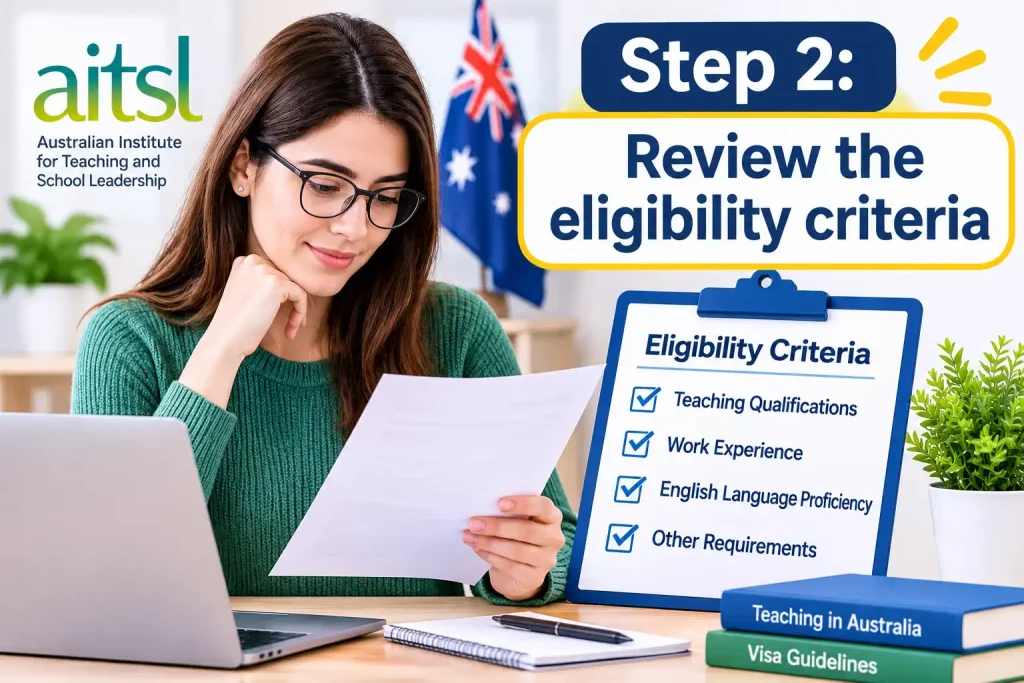
Open the official AITSL application process page. Check the four-year higher education requirement, relevant initial teacher education qualification and English language pathway.
Step 3: Select your teaching occupation

Choose the occupation that matches your qualifications and download its specific assessment checklist.
Step 4: Read the Application Guide

Review the latest guide carefully. It explains the evidence, document standards and application conditions.
Step 5: Prepare your supporting documents

Organise your passport, identity records, award certificates, transcripts, supervised teaching practice evidence and English language documentation.
Step 6: Create an Applicant Portal account

Visit the official AITSL Application Process page and follow its Applicant Portal link.
Step 7: Complete your application

Enter your personal information, education history and nominated teaching occupation. Check that the details match your supporting documents.
Step 8: Upload the required files

Attach the documents requested for your particular occupation. Review each upload to ensure it is complete and readable.
Step 9: Pay the application fee

Follow the payment instructions displayed in the portal. Confirm the current fee before completing the transaction.
Step 10: Submit and retain your application details

Review your information before submission. Save your application reference and monitor the portal dashboard for requests or the final assessment outcome.
Application guidance
AITSL requires a complete application. Once submitted, additional documents generally cannot be added unless the organisation requests further information. AITSL+1
AITSL Skills Assessment Fees
Applicants must pay the applicable assessment fee when submitting their skills assessment application through the AITSL Applicant Portal.
The fees depend on the service requested. The following figures are taken from the fee information supplied for this guide and should be checked against the current official fee schedule before payment.
| Service | Fee (AUD) | Purpose |
|---|---|---|
| Skills Assessment Application | $1,198 | Initial migration skills assessment |
| Skilled Employment Statement (SES) | $265 | Optional employment statement |
| Appeal of Assessment Outcome | $938 | Review of an assessment decision |
These fees are stated as GST-exempt and payable in Australian dollars.
Understanding the different fees
Skills Assessment Application Fee
This is the main payment required when applying for an AITSL migration skills assessment. It covers the assessment of your educational qualifications and English language evidence.
Skilled Employment Statement Fee
The Skilled Employment Statement is an optional service for eligible applicants who have already received a suitable skills assessment. It provides information about relevant skilled employment for migration points purposes.
Appeal Fee
If an applicant disagrees with an assessment decision, they may have the option to submit an appeal within the permitted timeframe and pay the applicable fee.
Before making a payment, visit the official AITSL Skills Assessment page to check the latest charges and service conditions.
AITSL Processing Times and Application Tracking
Processing time is an important consideration for international teachers planning to migrate to Australia. Applicants should allow enough time for document preparation, assessment and any additional immigration procedures.
The supplied reference information indicates an estimated processing period of approximately four to six weeks for assessment-ready applications. However, this should not be treated as a guaranteed timeframe. Actual processing periods can change depending on application volumes and individual circumstances.
What can delay an AITSL application?
Several issues may affect how quickly an application is assessed:
- Missing academic transcripts.
- Incomplete identity documents.
- Unclear or unreadable document scans.
- Incorrect occupation selection.
- Insufficient supervised teaching practice evidence.
- IELTS results that do not meet the required scores.
- Documents requiring additional verification.
- Incomplete English translations.
Best practice: Submit a complete application rather than rushing through the process. Checking every document before payment can help prevent avoidable delays.
How to check your application status
Applicants should use the AITSL Applicant Portal to manage their application.
The general process is:
- Open the official AITSL website.
- Navigate to the Teacher Migration Services section.
- Select the skills assessment application information.
- Follow the Applicant Portal link.
- Sign in using your registered account details.
- Review your application dashboard and any available notifications.
AITSL communicates assessment outcomes through its designated application channels. Applicants should follow the latest portal instructions rather than rely on informal processing updates.
Understanding AITSL Skills Assessment Outcomes
After reviewing your application, AITSL issues an assessment outcome based on the evidence provided.
For applicants seeking skilled migration, receiving a suitable outcome is an important step before proceeding with the relevant visa application.
Suitable Assessment Outcome
A suitable outcome means that the applicant has met the applicable AITSL requirements for their nominated occupation.
Depending on the service and current assessment arrangements, successful applicants can access their assessment outcome documentation through the Applicant Portal.
Unsuitable Assessment Outcome
An unsuitable result means that one or more assessment requirements have not been satisfied.
Possible reasons include:
- The qualification does not meet the required standard.
- The initial teacher education programme is not suitable.
- The supervised teaching practice evidence is insufficient.
- The English language requirement has not been met.
- Required supporting documents are missing or inadequate.
Applicants should carefully read the reasons provided in their outcome notification before deciding what to do next.
Can you appeal an AITSL assessment decision?
Applicants who disagree with an assessment outcome may have access to an appeal or review process, subject to AITSL’s current rules.
Before submitting an appeal:
- Read the assessment outcome letter carefully.
- Identify the specific reasons for the unsuitable decision.
- Review the relevant assessment criteria.
- Check the appeal eligibility and submission deadline.
- Prepare any permitted supporting explanation or evidence.
- Follow the official appeal instructions.
The supplied reference information mentions a 60-day appeal period. Always confirm the applicable deadline in your actual outcome notification and current AITSL appeal policy.
Skilled Employment Statement: What Is It?
The Skilled Employment Statement (SES) is an optional service associated with AITSL’s migration assessment process.
It provides an assessment of relevant skilled employment for eligible teachers who have received a suitable skills assessment.
This service may be useful to applicants who need employment information for their skilled migration points assessment.
However, an SES is not a visa approval, teacher registration certificate or employment offer.
Before applying, check:
- Whether your occupation is eligible.
- Whether your skills assessment outcome meets the requirements.
- Which employment periods can be considered.
- What supporting employment documents are required.
- The current application fee and submission procedure.
Common Mistakes to Avoid When Applying Through AITSL
A skills assessment requires careful preparation. Even applicants with relevant teaching qualifications can experience difficulties if their supporting evidence does not match the assessment criteria.
Here are some common mistakes and ways to prevent them.
| Common mistake | How to avoid it |
|---|---|
| Choosing the wrong occupation | Compare your qualifications with the official occupation checklist. |
| Providing incomplete transcripts | Obtain full academic records covering every relevant study year. |
| Missing teaching placement evidence | Request an official statement from your university. |
| Using General Training IELTS | Check that you have completed Academic IELTS where required. |
| Submitting unclear scans | Upload colour documents at the specified resolution. |
| Forgetting translations | Include complete English translations for non-English documents. |
| Ignoring portal notifications | Check your Applicant Portal regularly. |
| Assuming AITSL grants registration | Contact the relevant state or territory registration authority. |
A useful recommendation: Keep a separate digital folder for identification, qualifications, transcripts, English test results and professional placement evidence. This makes it easier to locate documents if you need to review or update your application.
FAQs
Final Thoughts
AITSL plays an important role in maintaining professional teaching standards and supporting the development of Australia’s education workforce. Its website provides valuable information for new graduates, experienced educators and overseas-qualified teachers exploring opportunities in Australia.
For prospective teachers, understanding the Australian Professional Standards for Teachers and initial teacher education requirements is a useful starting point. International educators should pay particular attention to occupation eligibility, academic qualifications, supervised teaching practice and English language requirements before submitting a migration skills assessment.
The best approach is to use the official AITSL website as your primary information source, prepare your documents carefully and check the requirements of the relevant teacher registration authority.
Read More:
NSW General Boat Driving Licence: Complete User Guide
Connect DET: How to Access and Use the WA Department of Education Portal
QuickCliq: Complete User Guide for Parents and School Communities in Australia
LeapFrog Australia: A Complete Guide to Learning Devices, Accounts and Online Support
ACAP Student Portal: Login, Student Access, Features and Complete User Guide