Managing your Australian tax obligations is much easier when you know where to find your records, how ATO online services work and what you need before lodging your return. The Australian Taxation Office (ATO) is the government agency responsible for administering Australia’s tax and superannuation systems, and its online services allow individuals to manage many parts of their tax affairs.
For most individuals, myTax is the main online service for lodging an income tax return. It is accessed through a myGov account linked to the ATO. Information supplied to the ATO by employers, banks, government agencies and other organisations may be pre-filled into your return, but you are still responsible for checking the details and adding anything that is missing.
This guide covers the main ATO tax information relevant to individuals, including employees, students and workers preparing an Australian tax return.
What Is the ATO?
The Australian Taxation Office is the Australian Government agency that administers the country’s tax and superannuation systems. Its website provides information and online services for individuals, businesses and other taxpayers.
For individuals, ATO services and information cover areas such as:
- Income tax
- Tax returns
- Tax deductions
- Tax File Numbers (TFNs)
- Superannuation
- Medicare levy information
- Tax rates
- Payment arrangements
- Notices of assessment
- Income statements
- Working-from-home expenses
- Self-education expenses
- Work-related expenses
Once the ATO service has been connected to your myGov account, you can also access ATO online services through myGov.
The usual online tax-return process
For an individual lodging a tax return online, the general process is:
myGov → ATO online services → myTax → Review information → Add income and deductions → Calculate → Submit
The ATO’s myTax service is its online system for lodging individual tax returns.
Australian Tax Rates Explained
Australia has a progressive income tax system for resident individuals. Rather than applying one tax rate to your entire taxable income, different portions of your income are taxed at different rates.
For the 2025–26 income year, the supplied information gives these resident tax rates:
| Taxable income | Rate |
|---|---|
| $0 – $18,200 | 0% |
| $18,201 – $45,000 | 16% |
| $45,001 – $135,000 | 30% |
| $135,001 – $190,000 | 37% |
| $190,001 and above | 45% |
The 16%, 30%, 37% and 45% resident rates apply under the legislated tax-rate structure for 2024–25 and later income years.
How the Tax Brackets Apply
Being in a higher tax bracket doesn’t mean your entire taxable income is taxed at that higher percentage.
For example, if your taxable income is within the $45,001–$135,000 bracket, the full amount isn’t simply taxed at 30%. The lower portions are dealt with under the preceding tax brackets, with the higher rate applying only to the relevant portion above the applicable threshold.
This progressive system matters when estimating how much tax you may need to pay. Your final result can also be influenced by deductions, offsets, Medicare-related amounts and other personal circumstances.
Medicare Levy
The Medicare levy is generally calculated separately from ordinary income tax. The information supplied for this guide identifies the standard Medicare levy as 2% of taxable income, although the amount that applies to an individual can vary depending on their circumstances.
Some higher-income taxpayers who don’t have appropriate private patient hospital cover may also be subject to the Medicare Levy Surcharge (MLS).
Because several factors can affect a tax outcome, using a basic percentage of your income isn’t enough to accurately predict your refund or tax bill. The ATO’s online calculator and your completed return provide a more useful assessment.
Fore More Information:
Visit Homepage
Get Ready Before Starting Your ATO Tax Return
Preparing your records before opening myTax can make the lodging process considerably easier. Having your identification details, income information and deduction records ready also makes it easier to check the information already supplied by the ATO.
Keep Your TFN Available
Your Tax File Number (TFN) is your personal identifier within Australia’s tax system. Keep it secure and only provide it to the ATO or other authorised organisations when appropriate.
If you can’t remember where you recorded your TFN, the ATO provides information about how you can find it.
Have Your Bank Details Ready
If you’re expecting a tax refund, you’ll want your Australian bank details available. These include:
- BSB
- Account number
- Account name
Providing the correct details helps ensure your refund can be paid into your nominated account.
Check Your Income Information
The ATO may already have information about several types of income. Depending on your circumstances, your return may include:
- Employment income
- Bank interest
- Dividends
- Government payments
- Private health insurance information
- Other reportable income
For most people, the ATO says pre-fill information is generally available by the end of July. Waiting until more information has been received can make checking your return easier, but pre-filled information doesn’t remove your responsibility to make sure the return is complete and accurate.
Keep Evidence for Your Expenses
If you plan to claim deductions, keep records that support the expenses. Depending on what you’re claiming, useful records can include:
- Receipts
- Tax invoices
- Work-related travel records
- Timesheets
- Working-from-home hour records
- Asset purchase records
- Donation receipts
- Education expense records
An expense isn’t automatically deductible just because it has some connection with your work. You need to satisfy the relevant ATO requirements and keep suitable evidence.
Setting Up myGov and ATO Online Access
If you’re lodging an Australian tax return online for the first time, you’ll first need access to ATO online services.
Begin by creating a myGov account if you don’t already have one. Once your account is set up, you can add or link the Australian Taxation Office service.
The linking process requires identity verification. The information and options shown can vary depending on your circumstances and the records already held by the ATO. A TFN is used as part of the identity-verification process when linking ATO online services.
What to Have Ready When Linking the ATO
Before starting the linking process, it can help to have relevant information available, including:
- TFN
- Personal details
- Address information
- ATO documents, where applicable
- Bank or superannuation details when requested
- Other accepted identity information
Security reminder: Don’t give your TFN, myGov password or verification information to anyone who doesn’t have a legitimate reason to receive it.
Accessing myTax Through ATO Online Services
After you’ve successfully linked the ATO to myGov, you can access the online tax-return system.
Open your myGov account
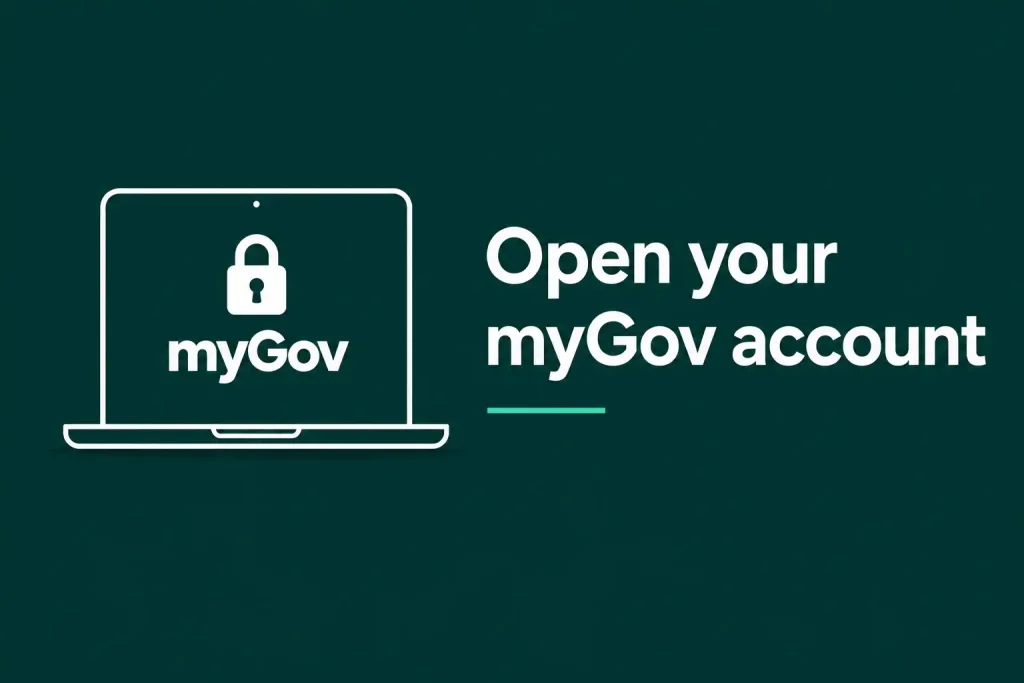
Sign in to your own myGov account.
Select the ATO service

From your linked services, choose the Australian Taxation Office.
Locate the tax-return service
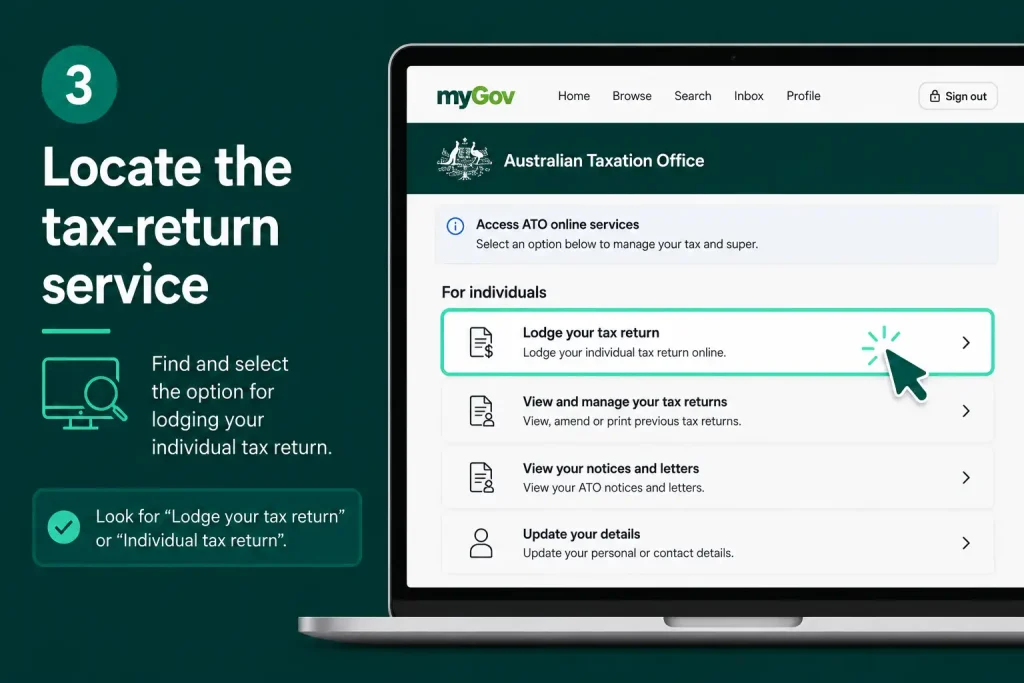
Within ATO online services, select the appropriate option for lodging an individual tax return.
Open myTax
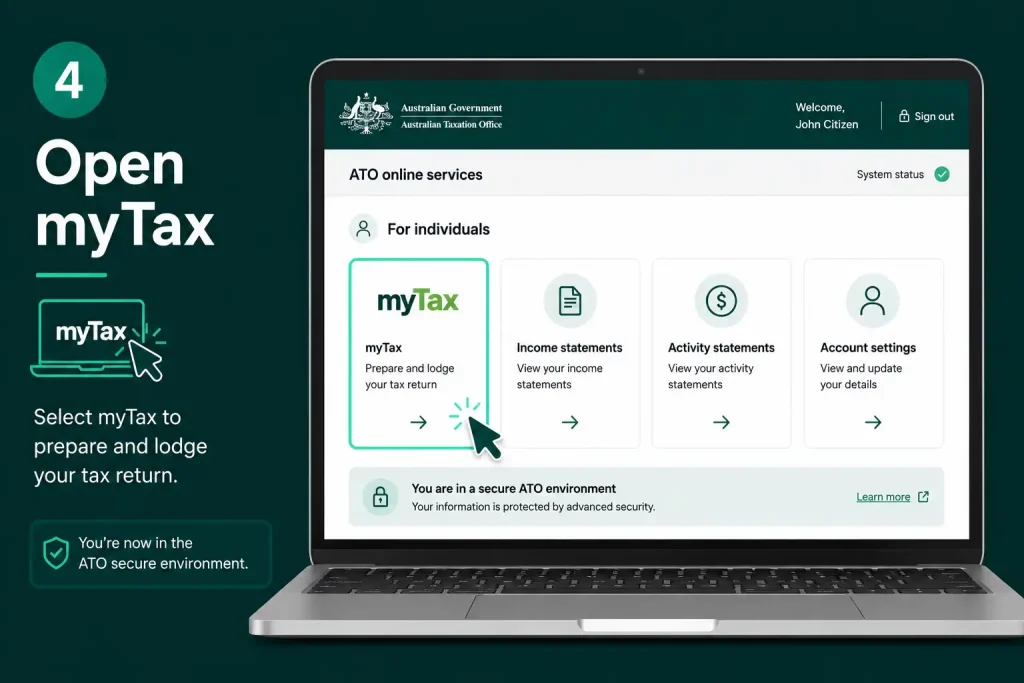
Follow the prompts to access your return and review or enter the required information.
Choose the correct income year

Check that you’re completing the correct financial year before entering or confirming figures.
The Australian income year generally runs from 1 July to 30 June. The ATO states that individual returns generally need to be lodged, or a registered tax agent engaged, by 31 October.
When Is the Best Time to Lodge a Tax Return?
The timing of your return can matter because some information may not yet have reached the ATO if you lodge too early.
For most people, the ATO recommends waiting until late July, when more pre-filled information is generally available. Employers, banks and other third parties may provide income information to the ATO during this period.
Pre-fill is useful, but it isn’t a replacement for reviewing your return yourself.
Treat the pre-filled information as a starting point. Check each relevant section, correct anything that is wrong and add income or other information that the ATO hasn’t received.
A Simple Tax-Time Timeline
| Period | What to do |
|---|---|
| 1 July | New income year begins |
| Early July | Start organising your records |
| Late July | Pre-fill information is generally more complete for most people |
| July–October | Review, prepare and lodge your return |
| 31 October | General self-lodgment deadline |
The exact timing of pre-filled information can differ from person to person, so check your ATO account rather than assuming that every record will appear on a particular date.
Checking Your Pre-Filled Tax Information
One of myTax’s most useful features is the ability to pre-fill information the ATO has already received.
For instance, employment income may appear in your return after your employer has reported it to the ATO. Even so, you shouldn’t automatically assume that every figure is correct or that all of your income has been included.
Before submitting your return, consider whether:
- You worked for more than one employer
- Every employer is listed
- You earned bank interest
- You received government payments
- You had investment income
- You earned freelance or gig-economy income
- You received income from another source
- The amounts match your own records
The ATO advises taxpayers to review pre-filled information, correct inaccurate details and include income that hasn’t already been reported.
Other Income You May Need to Report
Salary isn’t the only type of income that may need to appear on your tax return.
Depending on your circumstances, you may also need to account for:
- Bank interest
- Dividends
- Capital gains
- Side-business income
- Freelance work
- Sharing-economy income
- Foreign income
- Government payments
The ATO highlights the need to include applicable income such as cash jobs, sharing-economy earnings, income from a second job, foreign income and capital gains.
Understanding Tax Deductions
A tax deduction can reduce your taxable income when the expense meets the applicable requirements.
For many work-related expenses, three basic questions can help you decide whether you need to investigate a deduction further:
Did you pay for the expense yourself?
Was the expense connected with earning your income?
Do you have evidence to support the claim?
If the answer to any of these questions is no, check the specific ATO rules before including the expense in your return.
Common Types of Deductions
Depending on your circumstances, potentially deductible expenses can include:
- Working-from-home expenses
- Tools and equipment
- Work-related travel
- Self-education
- Donations
- Tax-agent fees
- Other eligible work expenses
Personal expenses generally can’t become deductible simply because you also happen to work.
Working-From-Home Tax Deductions
Working from home is an area where accurate records are particularly important. The method you use to calculate your claim determines what information and evidence you need to retain.
Under the supplied ATO information, the fixed-rate method for working-from-home expenses is 70 cents per hour from 1 July 2024.
The fixed-rate method can cover eligible additional running expenses under the relevant ATO rules, provided you meet the required conditions and keep the necessary records. You also can’t claim the same expense more than once.
Record the Hours You Work From Home
If you’re using the fixed-rate method, keep a record of the actual hours you worked from home.
Depending on your circumstances, this could be a timesheet, roster, diary or another suitable record. The ATO’s guidance includes an example involving a taxpayer who records their working-from-home hours and applies the 70-cent rate to those hours.
The Actual-Cost Method
The actual-cost method is another way to calculate eligible working-from-home deductions. It involves working out the work-related portion of eligible expenses according to their actual costs.
This approach generally involves more detailed records and calculations, but it may be suitable when it provides a better reflection of your deductible expenses.
ATO Tax Return 2026: Income, Deductions and Final Checks
Once your personal details are confirmed in myTax, you can work through the sections needed to prepare your Australian tax return. Take your time here. Pre-filled information can save work, but it doesn’t mean every detail is necessarily complete.
Your ATO tax return should accurately represent your financial circumstances for the relevant income year.
Check Every Source of Income
The ATO may already have records of your employment income, bank interest and certain payments. Even when information has been pre-filled, you are responsible for checking it and reporting relevant income that isn’t already shown.
Employment income
Review each income statement carefully and check:
- Employer name
- Gross income
- PAYG withholding
- Income statement status
If you worked for several employers during the financial year, make sure you’ve considered every relevant income statement.
Interest from bank accounts
Interest earned from Australian bank accounts can form part of your assessable income. Your bank may report the amount directly to the ATO, but it’s still worth comparing the pre-filled figure with your own records.
Dividends and investment income
Check your return for dividends and other investment income you’ve received.
Tax treatment can become more involved when your investments include capital gains, managed funds or other investment types. If you’re uncertain about how a particular investment should be reported, check the relevant ATO guidance before lodging the return.
Government payments
Some government payments may be taxable and need to be included in your return.
Examples include:
- JobSeeker
- Youth Allowance
- Other taxable government payments
Don’t assume that every payment from the government is tax-free. The treatment depends on the particular payment.
Freelance, online and gig income
Income isn’t always earned through a traditional employer. Freelancing, online work and sharing-economy activities can create tax obligations depending on the circumstances.
If you’ve earned money from a side activity, don’t leave it out simply because it doesn’t appear on your employer’s income statement.
Getting Work-Related Expense Claims Right
A work-related expense isn’t automatically deductible just because it helped you perform your job. The applicable ATO rules depend on the expense and your individual circumstances.
A useful way to assess an expense is to work through these questions:
| Check | What it means |
|---|---|
| Did you pay for it? | You generally need to have personally incurred the expense. |
| Was it reimbursed? | An expense reimbursed by your employer generally can’t also be claimed as your deduction. |
| Is there a work connection? | The expense needs to have a connection with earning your income. |
| Do you have evidence? | Keep receipts and any calculations or other records required. |
| Is there a private component? | Only the eligible work-related portion may be deductible. |
This helps avoid a common mistake: treating personal spending as though the entire amount was a work expense.
Equipment, Tools and Technology
Computers, phones, tools and other equipment are commonly used for work. Whether you can claim the full cost immediately depends on factors such as the item’s value, nature and your circumstances.
For eligible depreciating assets costing more than $300, the cost generally can’t simply be claimed as an immediate deduction. Instead, depreciation may need to be calculated over the asset’s effective life, subject to the applicable rules.
Examples can include:
- A laptop used for work
- Work-related tools
- Computer accessories
- Certain software
- Protective equipment or clothing
Separate Work Use From Private Use
A device may be used for both professional and personal activities. If you purchase a computer for work but also use it privately, you generally can’t treat the entire purchase as work-related.
Instead, determine the appropriate work-related portion and apply the relevant ATO rules.
Record-keeping tip: Keep the purchase documents and evidence showing how you calculated the deductible work-related portion.
Work Travel and Vehicle Expenses
Travel expenses require a clear distinction between private journeys and travel connected with your work.
Travel between your home and your normal workplace is generally private and can’t simply be claimed as a work-related deduction.
There are circumstances where work travel may be deductible, including travel:
- Between two workplaces
- To visit clients
- To attend another workplace for work
- On an eligible work trip
The tax treatment depends on the nature and purpose of the journey.
If you use your own vehicle for eligible work-related travel, make sure you use the appropriate calculation method and keep the required records.
A common misconception
Travelling from home to your normal workplace doesn’t automatically become deductible because you talk about work during the journey.
What matters is the nature of the trip and whether it meets the applicable tax rules.
When Can You Claim Self-Education Costs?
Education expenses may qualify for a deduction when they have a sufficient connection with your current income-earning activities.
For example, training that maintains or improves skills you already use in your current employment may qualify when the relevant ATO requirements are met.
Studying to obtain a new job or move into an unrelated career, however, doesn’t automatically make the course deductible.
Before claiming a self-education expense, consider:
- Does the study have a direct connection with my current work?
- Does it maintain or improve my existing skills?
- Is the expense connected with earning my current income?
- Do I have the required records?
Keep relevant documents such as enrolment records, invoices and other supporting evidence.
Donations and Deductible Gifts
Eligible donations can potentially be claimed as tax deductions when the relevant requirements are satisfied.
The supplied tax guidance identifies gifts of $2 or more to eligible Deductible Gift Recipients (DGRs) as a common deduction area.
Before including a donation in your tax return, check that:
- The organisation is eligible.
- The payment qualifies as a genuine gift.
- You have evidence of the donation.
- You haven’t received a personal benefit that affects the tax treatment.
Keep the receipt or other acceptable evidence with your tax records.
Claiming Tax-Agent Fees
If you use a registered tax agent to prepare your tax affairs, certain fees connected with preparing your tax return may be deductible under the applicable rules.
Keep the tax agent’s invoice and any relevant supporting documentation.
It’s worth remembering that paying a professional doesn’t automatically make every amount deductible. The tax treatment depends on what the expense relates to.
Entering Deductions in myTax
When you reach the deductions section of myTax, avoid rushing through the entries. Start with the expenses you actually incurred during the financial year and then establish whether each one meets the relevant requirements.
A practical process is:
Work expense → Check eligibility → Calculate the work-related portion → Gather evidence → Enter the amount → Review
For example, someone working from home may first need to establish the number of eligible hours worked at home, then use the appropriate calculation method and retain the required records.
For an equipment purchase, you may need to determine whether the item qualifies for an immediate deduction or needs to be depreciated.
Different expenses are governed by different rules, so one calculation method shouldn’t automatically be applied to every claim.
Give Your Return a Final Review
After you’ve entered your income and deductions, myTax allows you to review the return and view an estimated result.
This is an important point to slow down and check the details before submitting.
Review:
- Personal information
- Residency information
- Employment income
- PAYG withholding
- Bank interest
- Dividends
- Government payments
- Other income
- Deductions
- Private-use adjustments
- Bank details
- Applicable offsets or other information
Why the Final Check Matters
An Australian tax return isn’t simply a matter of entering expenses and waiting for a refund.
Your final result can depend on taxable income, tax already withheld and other relevant factors. A deduction reduces taxable income; it doesn’t mean the full cost of that expense is returned to you as a refund.
Understanding Your Tax Result
After myTax calculates the return, you may find that you’re entitled to a refund or that you have an amount to pay.
If You Receive a Refund
A refund can arise when the tax you’ve already paid or had withheld during the year is greater than your final tax liability after the return has been calculated.
If you want the refund paid electronically, check that your nominated bank account details are correct.
If You Have Tax to Pay
Having an amount owing doesn’t necessarily mean that an error has occurred.
For instance, the tax withheld from your income during the year may not have been enough to cover your final liability.
The ATO will provide information about the amount payable and any applicable payment arrangements.
Keeping Your ATO Tax Records
Good record keeping can make future tax returns much easier and gives you evidence to support the information you’ve reported.
Keep documents relevant to your return, such as:
- Receipts
- Invoices
- Income statements
- Bank records
- Donation receipts
- Travel records
- Working-from-home records
- Asset purchase documents
- Education records
Digital copies can be particularly convenient because they can be stored and retrieved when needed.
Don’t depend on memory alone. Several months after making a claim, it can be difficult to remember exactly how an amount was calculated.
Common Mistakes to Avoid
Even a relatively straightforward tax return can contain errors. These are some areas worth checking carefully.
Treating private expenses as work expenses
Using something for work doesn’t automatically make a personal expense deductible.
Claiming an expense you’ve already been reimbursed for
If your employer has reimbursed an expense, you generally can’t claim that same expense as your own deduction.
Leaving out additional income
People can overlook side jobs, investment income and other taxable amounts when they focus only on their salary.
Trusting pre-filled information without checking it
Pre-filled information is useful, but compare it with your own records and correct anything that isn’t accurate or complete.
Applying the wrong working-from-home method
The fixed-rate and actual-cost methods have different requirements. Don’t combine them incorrectly or claim the same expense more than once.
Missing the lodgment deadline
For individuals lodging their own tax return, 31 October is the general deadline.
Different arrangements can apply when a registered tax agent is used, depending on your circumstances and the agent’s lodgment programme.
ATO Tax Return Checklist
Before submitting your 2026 tax return, use this final check.
Personal details
- Name and contact information checked
- Address checked
- Residency information answered correctly
- Bank details reviewed
Income
- Employment income checked
- PAYG withholding checked
- Bank interest checked
- Dividends checked
- Government payments checked
- Other income considered
Deductions
- Work-related expenses reviewed
- Working-from-home records checked
- Equipment and asset claims reviewed
- Travel expenses checked
- Self-education expenses checked
- Eligible donations considered
- Tax-agent expenses considered where applicable
Final submission check
- Figures compared with your records
- No expense claimed twice
- Private expenses excluded or apportioned
- Estimated result reviewed
- Declaration completed
- Return submitted
What Happens After Lodging Your Return?
Submitting your tax return is not necessarily the final step.
The ATO processes the lodged return and issues a Notice of Assessment once the assessment has been completed.
The notice can contain information about:
- Taxable income
- Tax payable
- Refund
- Other amounts
- Payment information
Keep your Notice of Assessment with your tax records.
If the ATO contacts you about your return, use the appropriate official channel to respond and provide supporting information when required.
Made an Error on Your ATO Tax Return?
Mistakes can happen. If you realise that something in a lodged return is wrong, don’t simply leave it as it is.
Check the ATO’s current guidance on correcting a tax return. Depending on what went wrong and your personal circumstances, you may be able to amend the return through ATO online services.
An error could involve:
- An incorrect income amount
- Income that was left out
- A deduction entered incorrectly
- Wrong personal information
- Another tax-related item that wasn’t included
Dealing with an error promptly is generally better than continuing with information you know is incorrect. Where the situation is complicated, obtaining professional tax advice may be appropriate.
Keeping Your ATO Login Secure
Your myGov and ATO accounts can contain sensitive financial and personal information, so protecting access to them is essential.
Always Start With Official Websites
When accessing your ATO tax services, begin from the official ATO or myGov website rather than using an unfamiliar login link sent by email, text message or another communication channel.
This is especially important when a message creates a sense of urgency.
Never Give Away Your Login Details
Keep information such as the following private:
- myGov password
- TFN
- Security codes
- Identity-verification information
Don’t provide these details to someone who has no legitimate reason to have them.
Be alert to tax scams
Scammers may pretend to represent government agencies and contact people about supposed tax debts, refunds or urgent account problems.
Government branding alone doesn’t prove that a message is genuine. If you’re unsure about a request, don’t use the links or contact details provided in the message. Instead, leave the message and access the official website independently.
ATO Tax Information for Students and Young Workers
Being a student doesn’t automatically mean you have no tax responsibilities.
Whether you need to lodge a return depends on your individual circumstances, including your income and other relevant factors. If you’ve worked during the financial year, it’s worth checking your obligations rather than assuming your student status settles the question.
Your income may include:
- Employment earnings
- Bank interest
- Government payments
- Casual work
- Income from more than one employer
- Freelance earnings
The ATO’s individual tax information can help you determine what applies to your circumstances.
Start Good Record-Keeping Habits Early
Your first job is a good time to start keeping tax records properly. Save income documents and receipts for expenses that may potentially qualify as deductions.
Keeping digital copies can make this easier. When tax time arrives, you’ll be able to find important records without having to search through old paperwork or rely on memory.
Tax Deduction or Tax Refund: What’s the Difference?
The terms tax deduction and tax refund are often used as though they mean the same thing, but they describe different parts of the tax process.
A tax deduction reduces your taxable income when the expense meets the relevant requirements.
A tax refund, on the other hand, is an amount returned to you when your final tax assessment shows that you have already paid or had more tax withheld than you ultimately owe.
A simple example
Suppose you have a $500 eligible deduction. That doesn’t normally mean you’ll receive $500 as a refund.
Instead, the $500 reduces the income used when calculating your tax liability. The actual effect on your final result depends on your circumstances and the applicable tax calculation.
This distinction is useful when deciding whether a work-related expense is worth claiming and when estimating its financial effect.
How Taxable Income Is Calculated
Your taxable income isn’t necessarily the same as the total amount of money you received during the financial year.
In simplified terms:
Assessable income − allowable deductions = taxable income
The resulting taxable income is then used as part of the broader tax calculation. Other factors can also affect the final amount, including applicable tax rates, offsets and Medicare-related amounts.
That’s why two people with similar total earnings can still end up with different tax outcomes.
ATO Tax Dates You Should Know
For an individual lodging their own tax return, 31 October is generally the key annual lodgment deadline.
The Australian financial year ends on 30 June, after which you can start preparing the return for that completed year.
| Date or period | What it means |
|---|---|
| 30 June | Australian financial year ends |
| July | Tax-return preparation period begins |
| Late July | Most pre-fill information is generally more available |
| 31 October | General deadline for self-lodged individual returns |
These are general dates rather than a substitute for checking your own obligations. Your circumstances may affect what applies, so confirm current requirements with the ATO.
ATO Tax Deductions at a Glance
The following table gives a quick overview of common expenses and the main point to consider.
| Expense | Potentially deductible? | What to check |
|---|---|---|
| Work-related equipment | Yes, where eligible | Asset and depreciation rules may apply |
| Working from home | Yes, where eligible | Keep the required hours and expense records |
| Work travel | Sometimes | Normal home-to-work travel is generally private |
| Self-education | Sometimes | The required connection with your income must exist |
| Eligible donations | Yes, where eligible | Recipient and gift requirements apply |
| Tax-agent fees | Potentially | Treatment depends on what the fee covers |
| Private expenses | Generally no | Personal spending isn’t automatically deductible |
Use this as a starting point rather than a final eligibility test. Deduction rules can depend on the specific expense and your circumstances.
ATO Tax FAQs
Final Thoughts
Managing your ATO tax obligations becomes much easier when you keep accurate records, review your income carefully and understand which deductions you can legitimately claim. The ATO’s online services and myTax make it convenient to prepare and lodge an individual tax return, while pre-filled information can save time when checked against your own records.
Before submitting your ATO tax return, take a final look at your income, deductions, personal details and bank information. Most importantly, use the official ATO website for the latest tax rates, deadlines and deduction requirements, as tax rules can change. With good preparation and careful checking, you can approach tax time with greater confidence and avoid common filing mistakes.
Read More:
DET Portal Login 2026: NSW Department of Education Student & Staff Guide
MyUNSW Login & Student Portal Guide 2026: Enrolment, Timetable, Results & zPass
Department of Transport and Main Roads (TMR) Queensland: Complete Online Services Guide 2026
ATO Online Services for Business Login 2026: Complete Portal Guide
ATO Online Services for Business Login 2026: Complete Portal Guide
Australian Passport Renewal 2026: Complete Online Guide
City of Perth Staff Portal 2026: Login, CI Anywhere, Intranet & Remote Access Guide